
When Your Teen Doesn't Want to Drive
Some parents are holding the keys back. Others can't get their kid to pick them up. Here's how to tell what's going on, and how to help without pushing too hard.
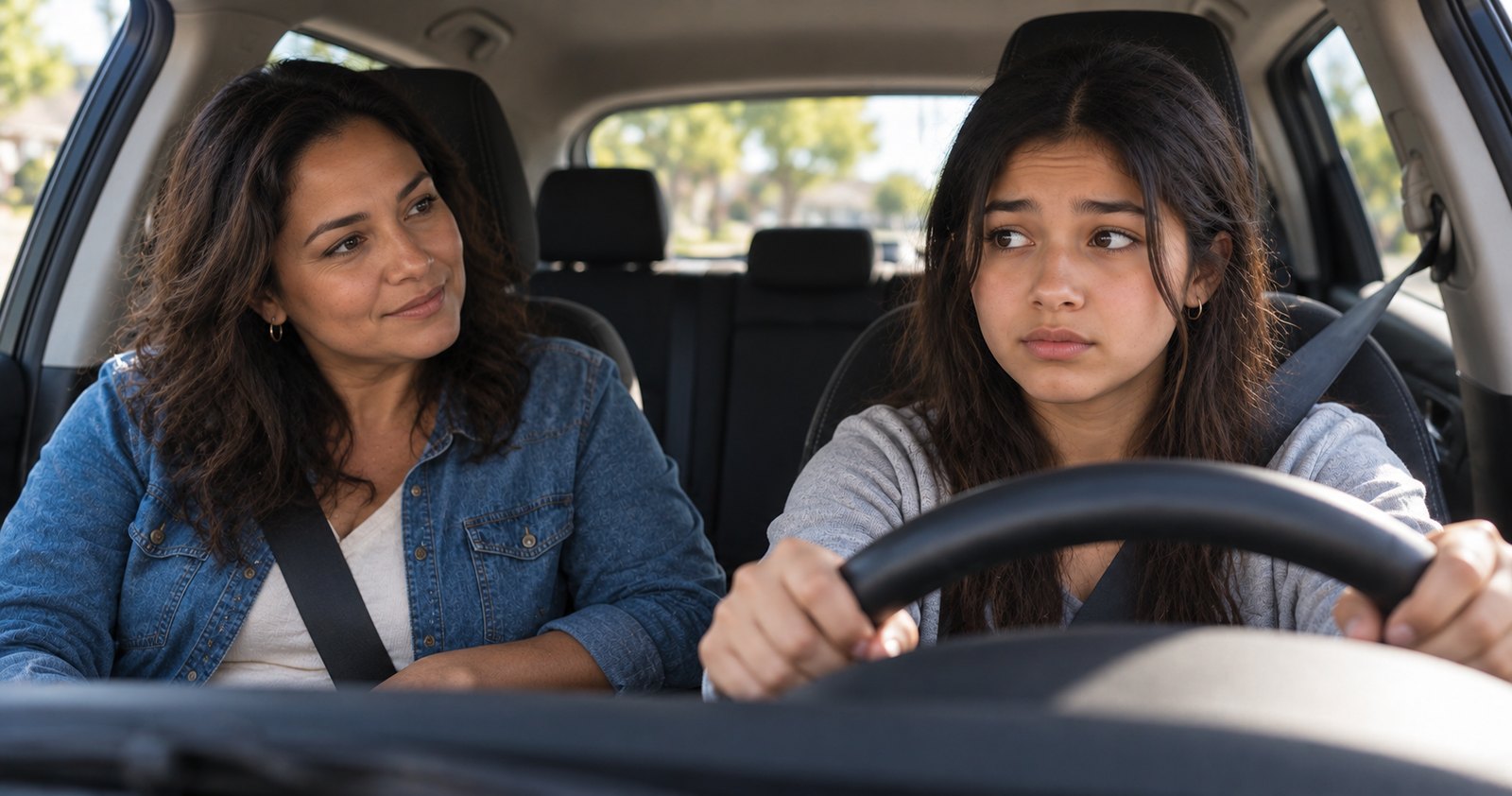
Most of what’s written about teen drivers assumes a kid pulling at the leash. Plenty of parents have the opposite problem. The birthday comes and goes, the permit sits in a drawer, and every suggestion of a practice drive gets a shrug, a sigh or a flat no.
If that’s your house, you’re not alone, and it’s not a sign that something’s wrong with your kid.
You’re in good company
Teens are getting licensed later than they used to. Researchers at the University of Michigan found that in 1983, 46% of 16-year-olds had a driver’s license. By 2014 it was under 25%. Even among 18-year-olds, the share fell from about 80% to about 60%.
When a national AAA Foundation survey asked young people why they waited, the most common answers were practical: no car of their own, other ways to get around, the cost of gas and driving. More than a third said they just didn’t get around to it.
So before you decide your kid is afraid, find out which kind of “don’t want to” you’re dealing with.
Four kinds of “I don’t want to”
“I don’t need to.” They get rides, they walk, the friends come to them. This is logistics. It’s also a little bit you, because the transportation department is still open for business.
“It’s a lot of money.” Sometimes teens notice the cost of insurance and gas before parents expect them to. Worth talking about honestly.
“I’ll do it later.” Plain inertia. Driving takes effort, and nothing is forcing the issue yet.
“I’m scared.” This one is different. Fear sounds like avoiding the subject, getting upset after a practice drive, or a kid who’s fine in a parking lot and shuts down near traffic.
The first three are mostly about motivation. The fourth is about confidence. The fixes are not the same.
If it’s motivation
Make driving useful to them, not to you. A part-time job, a sports schedule, a friend across town. Teens learn to drive faster when there’s somewhere they want to go.
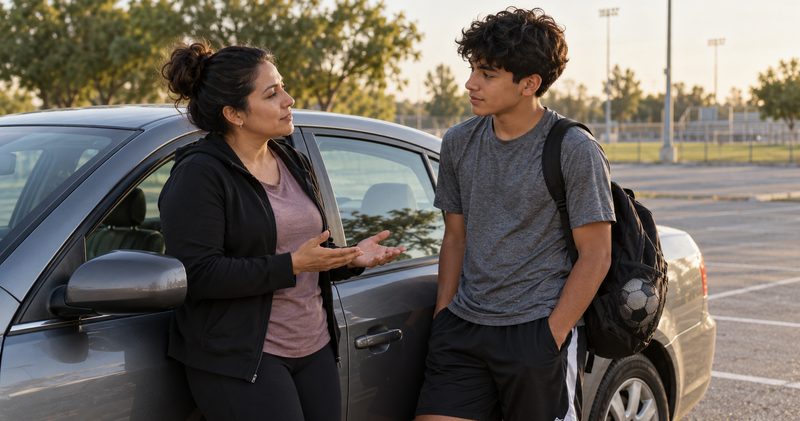
Then quietly close some of the transportation department’s hours. Not as a punishment. Just stop being the only option. “I can’t take you Thursday, but you can drive us both and I’ll ride along” is a perfectly reasonable sentence.
If it’s fear
Start by taking it seriously. A teen who’s nervous about driving has usually noticed something true: cars are heavy, traffic is fast, and new drivers crash a lot. They’re not wrong. They just don’t have the experience yet to feel in control.
So don’t argue them out of it. Build them out of it.
Find the specific thing. “Driving” is too big to be afraid of. It’s usually something narrower: left turns across traffic, merging onto the highway, parking with people watching, being honked at. Ask. Then you know where to start.
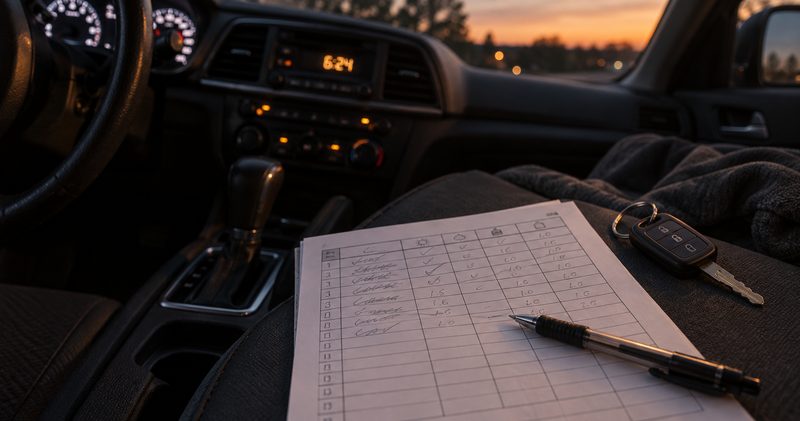
Go smaller than you think. An empty lot on a Sunday. The same quiet loop through the neighborhood, five days in a row. Short drives that end before they’re worn out. Confidence comes from doing the same thing until it gets boring.
Let them set the pace, inside a plan. “We’ll drive three times this week, and you pick the routes” gives them control without letting the whole thing drift.
Add one new thing at a time. Once the neighborhood is boring, add a busier road. Then a busier road at dusk. Never two new things on the same drive.
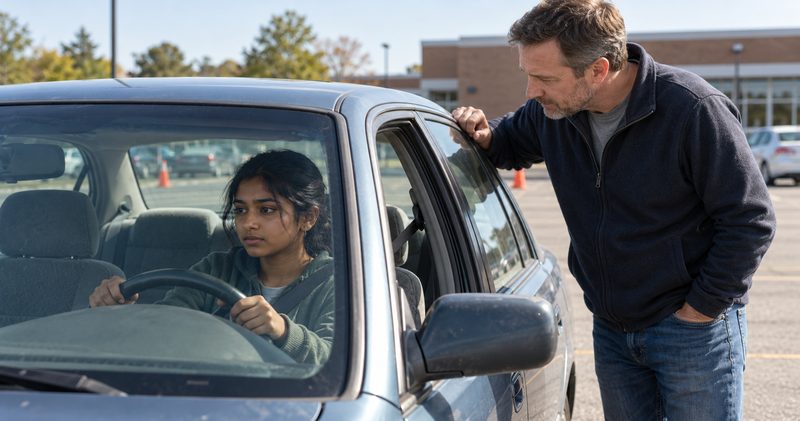
Watch your own nerves. A tense parent makes a tense driver. If you’re gripping the door handle, they know. Riding quietly is a skill for you, too.
Consider a course outside the family car. I paid for separate defensive driving programs for all four of mine, mostly to give them experience with risky situations in a controlled setting, without the real danger. Insurance didn’t give me any credit for it. For a nervous kid, that kind of setting can also be where confidence starts.
Don’t compare. Not to siblings, not to friends, not to you at 16. Comparison turns a skill problem into a character problem, and it makes the fear worse.
Why it’s still worth working on
You may be tempted to let it ride. They’ll drive when they’re ready, right?
Here’s the catch. In most states, the graduated rules that protect new drivers, like supervised hours and night and passenger limits, apply to drivers under 18. A teen who puts it off until 19 can often get a license with far less practice and none of those guardrails. They’ll still be a brand-new driver. They just won’t be one with you in the car.
Learning now, slowly, with you, is better than learning fast, alone, later. Should Your Teen Wait? has more on that trade-off.
When it’s more than nerves
Most driving fear fades with practice. But if your teen panics in the car, avoids it completely, or the fear shows up in a lot of other places too, it may be worth talking to your pediatrician or a counselor. Driving can wait. Their wellbeing comes first.
This week
Ask one question, and then listen: “What part of driving worries you most?”
Whatever they say, plan one short drive this week that’s only about that one thing, somewhere easy. Let them pick the time. Keep it short. End it while it’s still going well.
More on Readiness
- Sivak & Schoettle Recent Decreases in the Proportion of Persons with a Driver’s License across All Age Groups (UMTRI-2016-4). University of Michigan Transportation Research Institute, January 2016 (1983–2014 data) · public.websites.umich.edu
- Tefft, Williams & Grabowski Timing of Driver’s License Acquisition and Reasons for Delay among Young People in the United States, 2012. AAA Foundation for Traffic Safety, August 2013 (survey of 1,039 people ages 18–20) · aaafoundation.org
- Graduated licensing laws (state-by-state table). IIHS, Checked October 2026 · iihs.org
The research behind this page, with caveats, is in the DRVN evidence library: Only about half of young people get a driver’s license before 18, and at least 36% get licensed outside graduated licensing rules · The share of 16-year-olds with a driver’s license fell from 46% in 1983 to under 25% in 2014. Sources checked October 2026.