
The 50-Hour Myth: Why the Number in Your Log Is the Wrong Number
Your state wants hours. The research says the hours aren't what's doing the work.
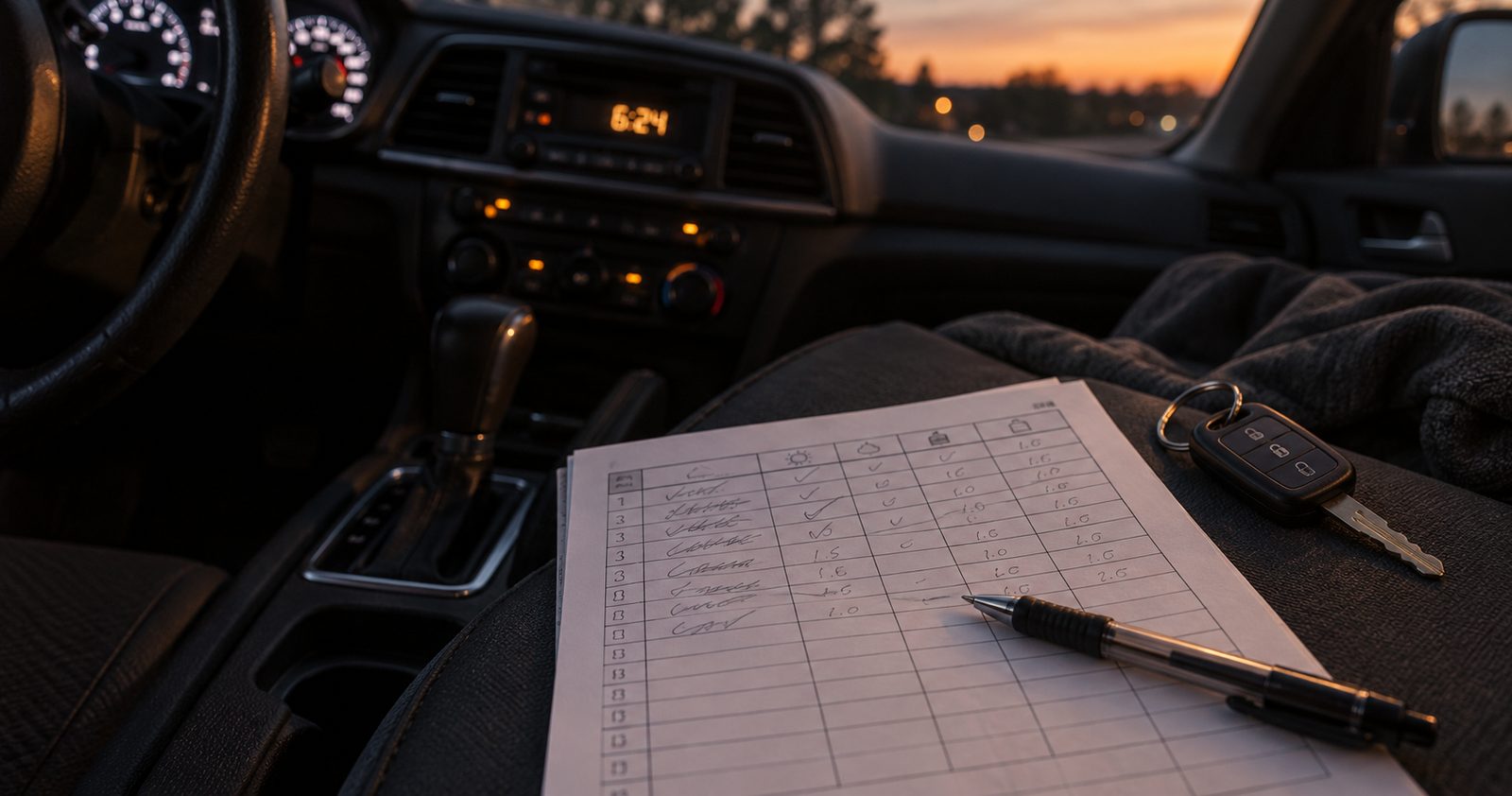
My wife was looking at our son’s logged practice time and said, “Fifteen hours? That can’t be right. It feels like fifty.”
It does feel like fifty. That is the entire problem in one sentence.
We had been driving together for months by then. Every errand, every run to practice, every trip to the store — he drove. It was constant. It was the background hum of our life, and it felt like an enormous investment of time, because in every way that matters to a parent, it was.
But what was being counted wasn’t how often we got in the car together. It was the time he actually spent driving.
Fifteen hours.
Unfortunately, fifteen hours does not perform like fifty.
The gap is bigger than you think, and it always runs the same direction
Nobody in my house was being dishonest. We had simply been estimating, and estimating is where this falls apart.
Think about what an ordinary practice drive actually contains. You go to the grocery store: eleven minutes there, twenty-five minutes inside, eleven minutes back. What you remember is the trip. What the odometer of practice records is twenty-two minutes. The drive to school is nine minutes. The run to a friend’s house is six.
Add to that the fact that supervising a new driver is exhausting in a way that stretches time. A twelve-minute drive where your kid is learning to judge a left turn does not feel like twelve minutes. It feels like a commitment.
So the felt number climbs much faster than the real one, and we make the decision about readiness using the felt number.
And with my oldest, nothing was counting at all
Somewhere in my house there is a piece of paper stating that my oldest son completed fifty hours of supervised driving.
It isn’t a lie. He drove. I was there for all of it.
What I could not tell you — not then, and not now — is what happened during those hours. I couldn’t tell you how many were after dark, or how many were in rain. I do know that a great many of them were spent on the same eight miles of road between our house and everywhere we regularly needed to go.
I signed it anyway. Of course I did. The form asked for a number, and I had a number.
Because the log measures the one thing nobody needs to know
There’s a design flaw sitting at the center of this whole system, and once you see it you can’t unsee it: the state needs a requirement it can verify, and the only thing it can verify from a kitchen-table form is a quantity.
So it asks for hours. Not conditions. Not skills. Not whether your teenager has ever merged into highway traffic or driven a road they had never seen before. Hours.
And in most states the verification is a parent’s signature. That’s it. There’s no audit. Nobody calls. The requirement is functionally an honor system, and I’d guess most families round up on it about the way I quietly did — not out of dishonesty, but because somewhere in month nine you stop tracking carefully and start estimating.
Which means the number on that form describes almost nothing about the driver it is certifying.
The study I wish someone had handed me
In a randomized controlled trial, researchers gave one group of families a structured practice program — specific goals, deliberate variety, night driving, bad weather. The other group practiced the way families normally practice.
Then they put all of the teenagers through an on-road safety evaluation.
In the group practicing normally, 15% drove badly enough that the evaluation had to be stopped early for safety. In the structured group, 6% did.
Roughly the same hours. Less than half the failure rate.
The hours weren’t doing the work. What happened inside them was.
That may be the most useful thing a parent can know about this process, and it is almost never in the material you’re handed when your kid gets a permit. You will get the hour requirement. You will not usually get the finding that the hour requirement is measuring the wrong variable.
What those families actually did differently
They weren’t driving more. They were driving differently, in a way that turns out to be embarrassingly simple to describe: they made sure their teenagers practiced in all six of the environments a driver actually encounters.
Residential streets. Busy commercial arterials. Rural two-lane roads. Limited-access highway. Darkness. Bad weather.
Not a token pass through each one. Real time — an hour or two minimum in every environment, and more in the ones that are hard.
Read that list, then think honestly about where your teenager has actually driven. For most families the answer is two of those, in daylight, on roads the kid could now navigate with their eyes closed, going places you were already going.
That isn’t laziness. It’s the natural result of practicing during errands, which is the only way most working parents can practice at all.
The Tuesday problem
This is where most of the advice in this category falls apart.
The guidance a parent receives is almost always written as though the hard part is knowing what a teenager ought to learn. Open any driver’s ed manual. The information is in there, it’s accurate, and it has been in there for decades.
The hard part isn’t knowing. The hard part is Tuesday.
It’s 5:40. You have a job and two other kids, it’s going to be dark in forty minutes, and you have to decide right now whether this drive to the grocery store is worth anything. Nobody writes for that parent. So the manual sits on the counter being correct, and you get in the car and drive to the store, and you count it.
I counted a lot of those.
What a useful hour looks like
The fix is small, and it costs no extra time. It’s three questions wrapped around a drive you were making anyway.
- What is the one thing we’re working on today? Not five things. One. Lane position. Gap judgment on left turns. Following distance. Say it out loud before you back out of the driveway.
- What’s new about this drive? A road he hasn’t driven. A time of day she hasn’t driven. Rain. A parking garage. If nothing is new, the drive is maintenance rather than practice — which is fine, as long as you don’t count it as progress.
- How did it actually go? Two minutes in the driveway afterward. What went well, specifically. One thing for next time. And if you’re keeping a real log, write down the skill and how it looked — not just the minutes.
Three questions. Maybe four minutes. No additional hours required.
So what number should you use?
If you want a target, use 70. That’s what the Insurance Institute for Highway Safety recommends, and it’s roughly double what some states ask for. Ohio wanted 50 hours from my kids. Iowa, where I live now, asks for 20.
But the number is the least important part of the plan, and there’s a better test. Before you sign anything, see whether you can answer these:
- Has my teenager driven at night, on an unfamiliar road, in the rain?
- Have they merged into real highway traffic more than once?
- Have they driven somewhere without me navigating for them?
- Have they made a left turn across a busy road without me telling them when to go?
If the answer to any of those is no, the hours don’t mean much. If the answer to all of them is yes, the hours probably never mattered.
In the DRVN Readiness Framework, those questions are about coverage and independence, two of the five things that count more than the total in the log.
DRVN Readiness Framework Control · Awareness · Judgment · Coverage · Independence. See how DRVN evaluates readiness
Why I ended up building something
When my oldest was learning, I went looking for a plan and found plenty of information and nothing I could use.
There were manuals. There were checklists. There were curricula written by people who clearly knew a great deal about driver education. What there wasn’t — what I actually needed at 5:40 on a Tuesday — was something that could tell me what to do with the next forty minutes, and then remember that we had done it.
So I built one. Not because it made sense on paper. Because it was something I could use, on the days I actually had, in the life I was already living.
The fifteen-hour conversation in my kitchen happened years later, with a younger kid — and it only happened because something was finally counting honestly. That number was uncomfortable. It was also the most useful thing anybody told us that year, because there was still time to do something about it.
That’s the difference between a requirement and a plan. A requirement asks what you did. A plan tells you what to do next.
Your state is going to ask you for a number. Give it the number.
Just don’t mistake it for the answer.
More on Readiness
- Mirman JH, Curry AE, Winston FK, et al. Effect of the Teen Driving Plan on the Driving Performance of Teenagers Before Licensure: A Randomized Clinical Trial. JAMA Pediatrics, 2014. doi:10.1001/jamapediatrics.2014.252 · pubmed.ncbi.nlm.nih.gov
- TeenDrivingPlan Research. Children’s Hospital of Philadelphia, Center for Injury Research and Prevention, Checked October 2026 · injury.research.chop.edu
- Teenagers. Insurance Institute for Highway Safety (IIHS), 2024 data · iihs.org
- Graduated Driver Licensing. Ohio Bureau of Motor Vehicles, Checked October 2026 · bmv.ohio.gov
- The Parent’s Supervised Driving Program (PDF). Iowa Department of Transportation, 2021 edition · iowadot.gov
- Graduated licensing laws (state-by-state table). IIHS, Checked October 2026 · iihs.org
- Learner’s and Intermediate License. Arkansas Department of Finance and Administration, Checked October 2026 · dfa.arkansas.gov
- Young Driver. Pennsylvania Department of Transportation, Checked October 2026 · pa.gov
The research behind this page, with caveats, is in the DRVN evidence library: Required supervised practice ranges from none to 65 hours depending on the state · Teens whose families followed a structured plan across varied environments were less likely to fail an on-road driving assessment. Sources checked October 2026.