
Road Test Day: What the Test Proves, What It Doesn’t, and What to Do That Afternoon
Twenty minutes with an examiner ends the permit year. The most important drive of the day is the one after it.
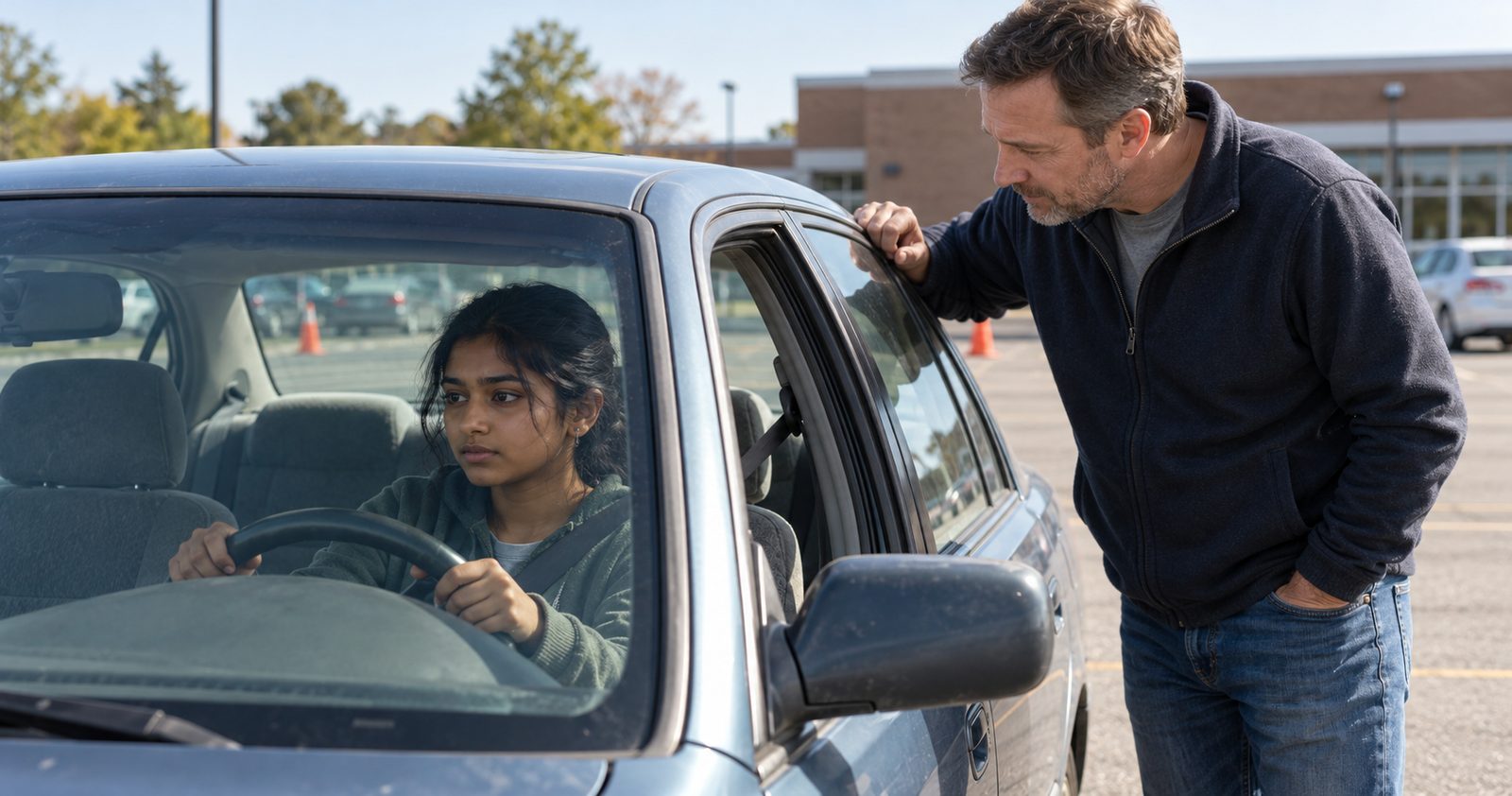
The strangest part of road test day is the twenty minutes you spend in the parking lot.
For a year, you have been in the passenger seat of every single drive. You’ve braked on a floor with no brake pedal more times than you can count. Now a stranger with a clipboard gets in, your kid pulls away, and you are standing next to a building with a vending machine and nothing to do but think about every lane change you ever let slide.
You will be more nervous than they are. That’s normal. Bring something to read. You won’t read it.
What does the road test actually check?
Road tests vary by state, but most of them come down to the same basic question: can this person follow the rules of the road for a short drive while someone official is watching?
The examiner is looking at the fundamentals. Full stops behind the line. Signals. Mirror and shoulder checks before every lane change. Staying near the speed limit, which means not over it and also not crawling. Lane position. Right of way. Usually some backing or parking. Many states also have a short list of errors that end the test on the spot, and the clearest one is anything that makes the examiner step in to keep the car safe.
Notice what that list is. It’s the stuff your teen learned in the first few months. A road test mostly measures whether the basics hold up under pressure. That’s worth measuring. It’s just not much.
What can’t the road test check?
No road test includes rain at night. Or an interstate merge at rush hour. Or a two-lane country road with no shoulder and a tractor coming the other way. Or a friend in the passenger seat holding up a phone. It happens in whatever weather shows up, at whatever time you booked, on the streets around one licensing office.
And in some states, there isn’t even that. In Arizona, for example, a teen who finishes a high school or private driver education course can have the road test waived. Plenty of kids get a license without anyone from the state ever watching them drive.
I’m not saying that to knock driver’s ed. I’m saying it so you know who is actually doing the final check in this system. It’s you. It was always going to be you.
The test asks whether they’ve met the requirements. It doesn’t ask what they’re ready to do with the license.
The week before
Don’t cram. The week before the test is not the time to introduce highway driving for the first time. You want them calm and doing things they’ve done a hundred times.
Drive the neighborhood around the testing site. Examiners use the streets nearby, so a couple of practice drives there takes the novelty out of the intersections, the speed limits and that one weird left turn every testing office seems to have.
Practice in the car they’ll test in. If they learned in your car and are testing in the other one, find out now that the mirrors, brakes and turning radius are different.
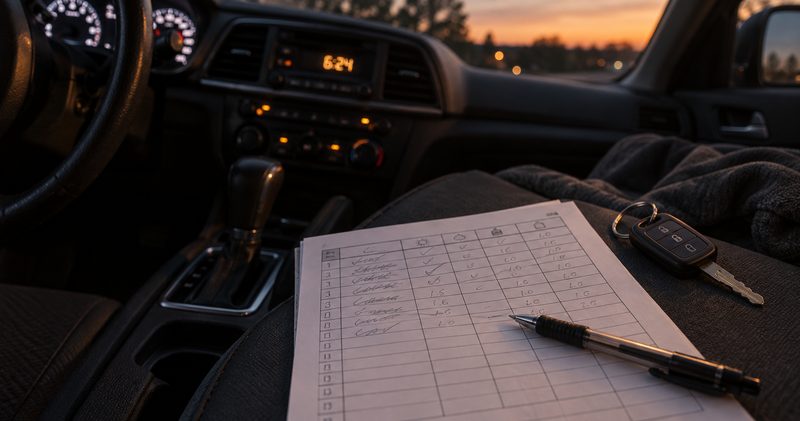
Run the boring checklist the night before. Permit, the practice log or certificate your state requires, registration, proof of insurance. Then walk around the car: brake lights, turn signals, horn, no warning lights on the dash. A burnt-out brake light can end the test before it starts, and you’ll be the one who has to explain that in the car on the way home.
Practice the full stop. I’d bet more teens lose points on rolling stops than on anything else, mostly because they learned to drive from us.
What if my teen fails the road test?
It happens to a lot of kids, and it’s not a disaster. It’s twenty minutes of feedback from a professional who doesn’t love your child and has no reason to be polite about it. That’s worth something.
Ask what the examiner marked. Then make the next few practice drives about exactly that. Most states let you retest after a short wait. Use the wait.
And if you suspected they weren’t ready and the test agreed, take a moment to appreciate that the system caught it. That’s the floor doing its job.
Passing tells you they met the state’s standard. Whether they’re ready to drive alone is a separate call, and DRVN looks at five things to make it: control, awareness, judgment, coverage and independence.
DRVN Readiness Framework Control · Awareness · Judgment · Coverage · Independence. See how DRVN evaluates readiness
If they pass
Congratulations. Take the picture. Let them be proud. It’s a real milestone, and it’s theirs.
Then remember what the license is. It’s permission. It isn’t a finish line, and the first few months afterward are the riskiest stretch of their driving lives. A National Institutes of Health study found crashes and near-crashes jumped about eightfold in the first three months after the license. The danger doesn’t peak during the permit year. It peaks right after this. (More on that in Is My Teen Ready to Drive Alone?)
So before you leave the parking lot, decide one thing: what is the first drive they’ll do alone? Not “wherever.” Pick it. A familiar route, in daylight, with no passengers, ideally somewhere they’ve driven dozens of times with you. School and back. Work and back. Their first solo drive should be boring on purpose.
Then decide what comes after that, and what doesn’t come yet. Night driving alone, friends in the car and long highway trips can each have their own day. Your state’s rules on passengers and curfews are the minimum. You’re allowed to be stricter, and you should keep riding along for the hard stuff for a while even after the logbook is done.
They’ll roll their eyes. That’s fine. They’ll also have a license, which means you’re finally free from 9:40 pickups. Everybody gets something.
The one thing to do before test day
Sit down with your teen the week before and agree on the first month after the license: where they can drive alone, when, and with whom. Write it down. Do it before the test, while they still need your signature, not after, when they have the keys.
It’s the easiest conversation you’ll get, and it’s only easy for about one more week.
More on Readiness
- Teen permit and license requirements. Arizona Department of Transportation, MVD, Checked October 2026 · azdot.gov
- Teen crash risk highest during first three months after getting driver’s license. National Institute of Child Health and Human Development (NIH), July 2018 · nichd.nih.gov
- Gershon P, Ehsani JP, Zhu C, et al. Crash Risk and Risky Driving Behavior Among Adolescents During Learner and Independent Driving Periods. Journal of Adolescent Health, 2018. doi:10.1016/j.jadohealth.2018.04.012 · pubmed.ncbi.nlm.nih.gov
The research behind this page, with caveats, is in the DRVN evidence library: Crashes and near-crashes were eight times as frequent in teens’ first three months of licensed driving as in their last three months on a permit. Sources checked October 2026.