
Ready Isn’t a Feeling: How to Know Your Teen Is Ready to Drive Alone
The state decides when they’re eligible. Whether they’re ready is your call, and you’re not exactly neutral.
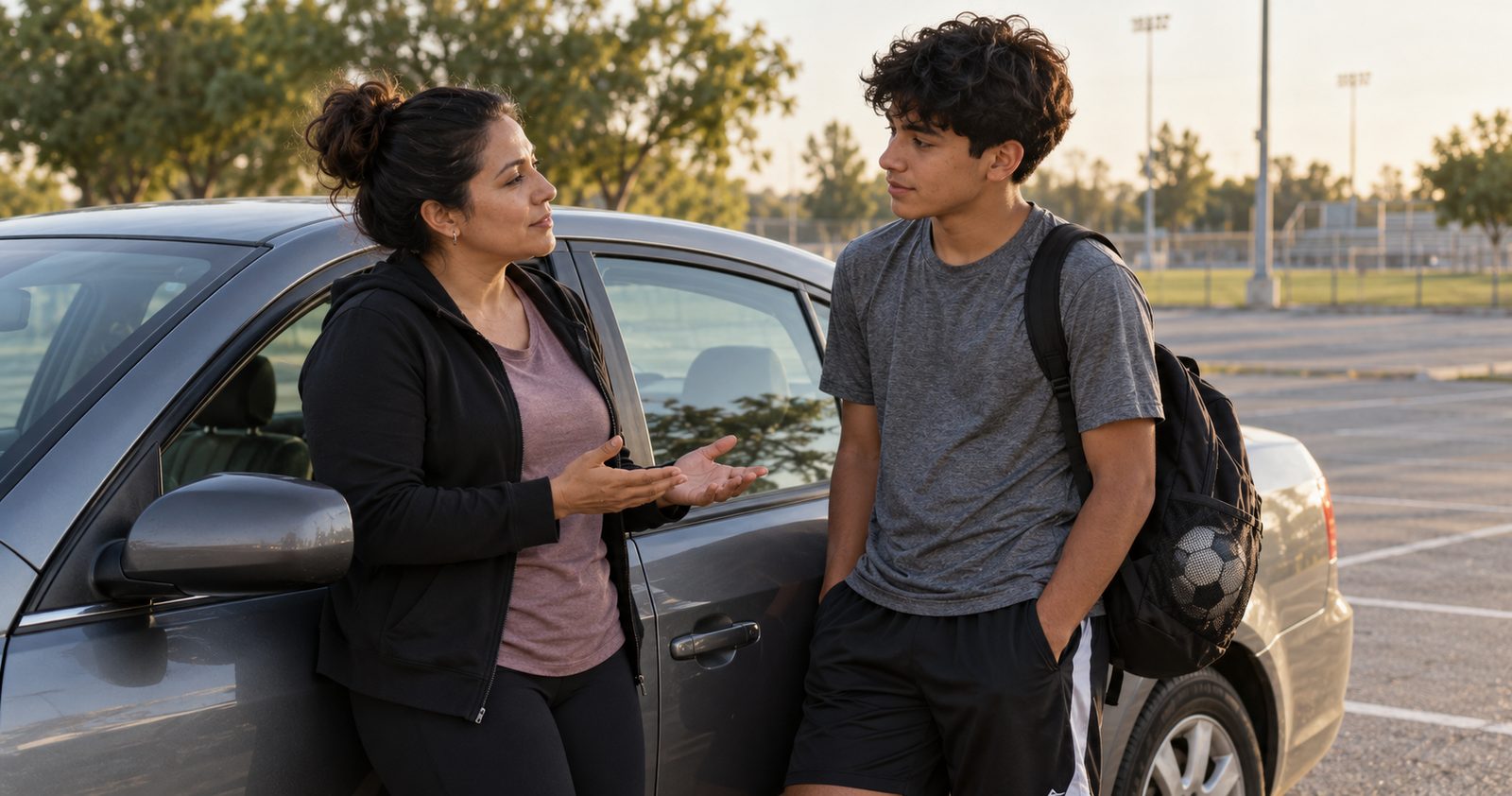
A teen is ready to begin driving alone when safe decisions increasingly come from them rather than from the parent in the passenger seat. Passing the road test and completing the required hours matter, but neither proves independent readiness on its own.
Here is something nobody says out loud: by the time your kid is old enough to drive, you are desperate for them to drive.
You have been the family transportation department for fifteen or sixteen years. School, practice, the friend’s house, the other friend’s house, the forgotten cleats, the 9:40 pickup from a thing that was supposed to end at 9. Then one day the state says this kid is eligible to drive themselves, and every tired cell in your body hears “ready.”
Those are not the same word. And you are the worst-positioned person in the world to tell them apart, because you badly want them to be the same.
The state sets eligibility. You set readiness.
Does passing the road test mean my teen is ready?
No. Passing the road test means your teen met the state’s licensing standard on one short drive. It doesn’t show how they handle night, rain, a highway they’ve never seen or a friend in the passenger seat.
The state’s job is a floor: an age, a number of logged hours, a written test, a short drive with an examiner. Once your teen clears it, the state is done. Readiness is a different question, and it’s yours.
| State requirement | Readiness |
|---|---|
| Can they legally drive? | Should they drive alone? |
| Minimum hours | Quality and coverage |
| Road test | Real-world judgment |
| Legal restrictions | Family-defined limits |
Hours are the clearest example of the difference:
Supervised hours range from none in some states to 65 in others. Find your state’s requirements.
IIHS lists at least 70 hours of supervised practice among its graduated-licensing best practices.
Don’t judge readiness by hours alone. Track coverage, judgment and independence.
Source: IIHS graduated licensing laws table and state licensing agencies, checked October 2026
I let the test decide
With my oldest, “is he ready?” never came up as its own question. He passed the road test. That was the answer. I didn’t think about it beyond that.
I don’t say that because something terrible happened. I say it because it’s how almost everybody does it, and because it means a fifteen-minute drive around the licensing office made a decision that I should have made over months. Road Test Day covers what the test actually measures.
Why does the readiness decision matter so much?
Because the riskiest stretch of learning to drive starts the day you get out of the car. Teens’ crash and near-crash rates jump sharply in the first months of driving alone, compared with their last months on the permit.
A study led by the National Institutes of Health put recording equipment in teenagers’ cars through their permit year and into their first year of driving alone. In the first three months after the license, their rate of crashes and near-crashes was about eight times what it had been in the last three months of supervised driving. And it didn’t come down over the rest of that first year.
Source: NIH (NICHD) naturalistic driving study, 2018 · Evidence Library
Same kid, same car, same roads. The only thing that changed was that you got out. So when you decide your teenager is ready to drive alone, you’re making the single biggest safety decision of this whole process. Most of us make it by default.
How do I know when my teen is ready to drive alone?
Look at where the driving decisions are coming from. DRVN breaks readiness into five things you can watch for on ordinary drives.
The DRVN Readiness Framework
DRVN evaluates readiness as more than hours or a passed road test. A teen is approaching independent readiness when they consistently demonstrate control, awareness, judgment, coverage and independence.
- ControlVehicle operation is smooth, consistent and largely automatic.
- AwarenessThe teen notices hazards and changing conditions without needing prompts.
- JudgmentThe teen chooses appropriate speed, following distance, gaps and responses.
- CoverageThe teen has meaningful experience across different roads, conditions and driving situations.
- IndependenceThe supervising adult is no longer supplying a significant portion of the driving decisions.
This is a DRVN framework, informed by research and nearly ten years of working with families. It is not a licensing standard, and it doesn’t replace your judgment. It gives that judgment something specific to look at.
How much of the driving are you still doing from the passenger seat?
Every “you’re clear,” “slow down” and “watch that car” is a decision you made for them. Readiness is when there’s almost nothing left to say.
Researchers who recorded families during the permit months found that almost a quarter of parents’ comments were telling the teen when it was clear to pull out. That’s one of the hardest calls in driving, and in a lot of cars the parent was making it.
Source: UNC Highway Safety Research Center, Goodwin et al., 2014
What are the signs a teen is ready?
Signs of readiness
- Notices hazards without prompting
- Adjusts speed for conditions
- Judges gaps consistently
- Handles unfamiliar situations calmly
- Recovers from mistakes safely
- Needs little routine coaching
- Can tell you when a drive is beyond them
Signs more practice is needed
- Frequent reminders about speed
- You still spot hazards first
- Inconsistent gap judgment
- Struggles on unfamiliar roads
- Overconfidence, or panic when things get complicated
- Avoids certain roads or conditions
Here’s how I’d check, on a normal drive.
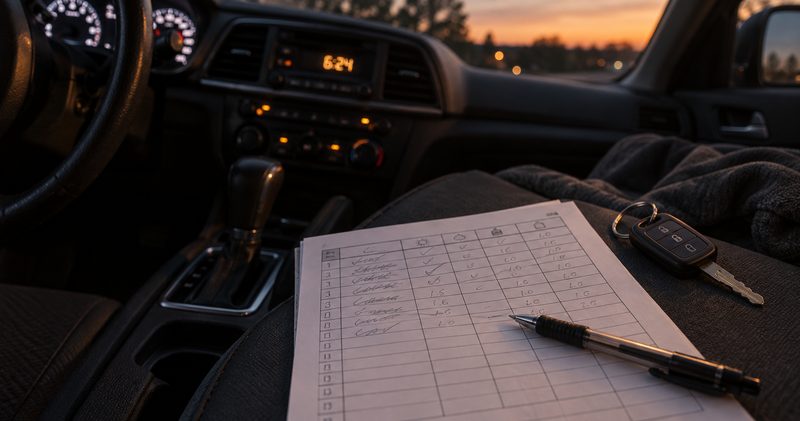
Count what you say. Keep a quiet tally of every time you speak up to help. Early on that number is huge, and it should be. Readiness is when it gets close to zero on a normal drive, and stays there. Not because you bit your tongue. Because there was nothing to say. (How to get there on purpose.)
Ask them what they see. Every so often, ask, “What are you watching right now?” A ready driver answers fast and specifically: the kid on the bike, the brake lights two cars up, the truck drifting toward the line. A driver who isn’t ready says “the road,” which is technically correct and tells you everything.
Let them navigate. Pick somewhere they’ve never driven and stay quiet. Plenty of teens who are smooth on their usual eight miles fall apart when they also have to figure out where they’re going. Alone, they always will.
Watch the second mistake. Everybody makes the first one. A ready driver misses a turn and takes the next one. A driver who isn’t ready misses a turn and makes a sudden lane change to save it.
If the gaps cluster in one place, say highways or night, that’s your practice plan. The Six Environments shows what teens should practice before driving alone, and The 50-Hour Myth explains why the hours in your log won’t tell you. If you log drives with the DRVN app, the drive history and route maps show where you’ve actually driven, so you aren’t guessing.
Can a teen be ready for some drives and not others?
Yes, and this is the part I wish I’d understood the first time. Ready isn’t a yes-or-no question. It’s ready for what.
A teen can be completely ready to drive themselves to school at 7:30 in the morning and nowhere near ready to drive home from a party at 11 with three friends in the car. Those are different drives. Treat them that way.
So don’t hand over the keys all at once. Hand them over in pieces. Familiar routes in daylight first. Then other daylight trips. Then a highway on their own. Then dark. Then a friend in the car. Keep doing the hard stuff, like night, rain or unfamiliar highways, together for a while after the license, even though the state says you don’t have to.
Your state probably runs a version of this already with passenger limits and a curfew. Those are the legal minimum. Nothing stops you from running a stricter version of your own, and your teenager will survive it. They will also complain, which is how you know it’s working.
What if my teen isn’t ready yet?
Then they’re not ready yet. The age on the license is the earliest your teen can go, not a deadline.
Make the conversation about specific things, not about them. “You’re not ready” lands as a verdict. “I want to see three more night drives and one trip on the interstate where I don’t say anything” is a plan with an end date. Teenagers can work with a plan. Honestly, so can parents. Should Your Teen Wait to Get Their License? covers how to say it, and the catch with waiting too long.
For the full picture, from the first drive to the first months alone, start with Teen Driving Safety for Parents.
This week
If your teen is within a few months of the license, do one thing: take a normal drive together and count. Every prompt, every “careful,” every hand that drifts toward the dashboard. Don’t tell them you’re doing it.
That number is the most honest readiness test you have. Nobody from the state is ever going to ask you for it. That’s exactly why it’s worth knowing.
More on Readiness

- Teen crash risk highest during first three months after getting driver’s license. National Institute of Child Health and Human Development (NIH), July 2018 · nichd.nih.gov
- Gershon P, Ehsani JP, Zhu C, et al. Crash Risk and Risky Driving Behavior Among Adolescents During Learner and Independent Driving Periods. Journal of Adolescent Health, 2018. doi:10.1016/j.jadohealth.2018.04.012 · pubmed.ncbi.nlm.nih.gov
- Graduated licensing laws (state-by-state table). IIHS, Checked October 2026 · iihs.org
- Goodwin et al. Parent comments and instruction during the first four months of supervised driving: an opportunity missed? (Accident Analysis & Prevention, 2014). UNC Highway Safety Research Center, 2014 (50 North Carolina families, in-vehicle recordings) · hsrc.unc.edu
- Teenagers. Insurance Institute for Highway Safety (IIHS), 2024 data · iihs.org
- Learner’s and Intermediate License. Arkansas Department of Finance and Administration, Checked October 2026 · dfa.arkansas.gov
- The Parent’s Supervised Driving Program (PDF). Iowa Department of Transportation, 2021 edition · iowadot.gov
- Graduated Driver Licensing. Ohio Bureau of Motor Vehicles, Checked October 2026 · bmv.ohio.gov
- Young Driver. Pennsylvania Department of Transportation, Checked October 2026 · pa.gov
- Simons-Morton BG, Ouimet MC, Zhang Z, et al. Crash and Risky Driving Involvement Among Novice Adolescent Drivers and Their Parents. American Journal of Public Health, 2011. doi:10.2105/AJPH.2011.300248 · pubmed.ncbi.nlm.nih.gov
The research behind this page, with caveats, is in the DRVN evidence library: Required supervised practice ranges from none to 65 hours depending on the state · Crashes and near-crashes were eight times as frequent in teens’ first three months of licensed driving as in their last three months on a permit · Time behind the wheel alone doesn’t bring a new driver’s risk down quickly · During the first months of supervised driving, more than half of parents’ comments are about operating the car, and almost a quarter tell the teen when it’s clear to pull into traffic. Sources checked October 2026.