
Are You Still Driving From the Passenger Seat?
The goal of the permit year is to make yourself unnecessary. Most of us never get around to firing ourselves.
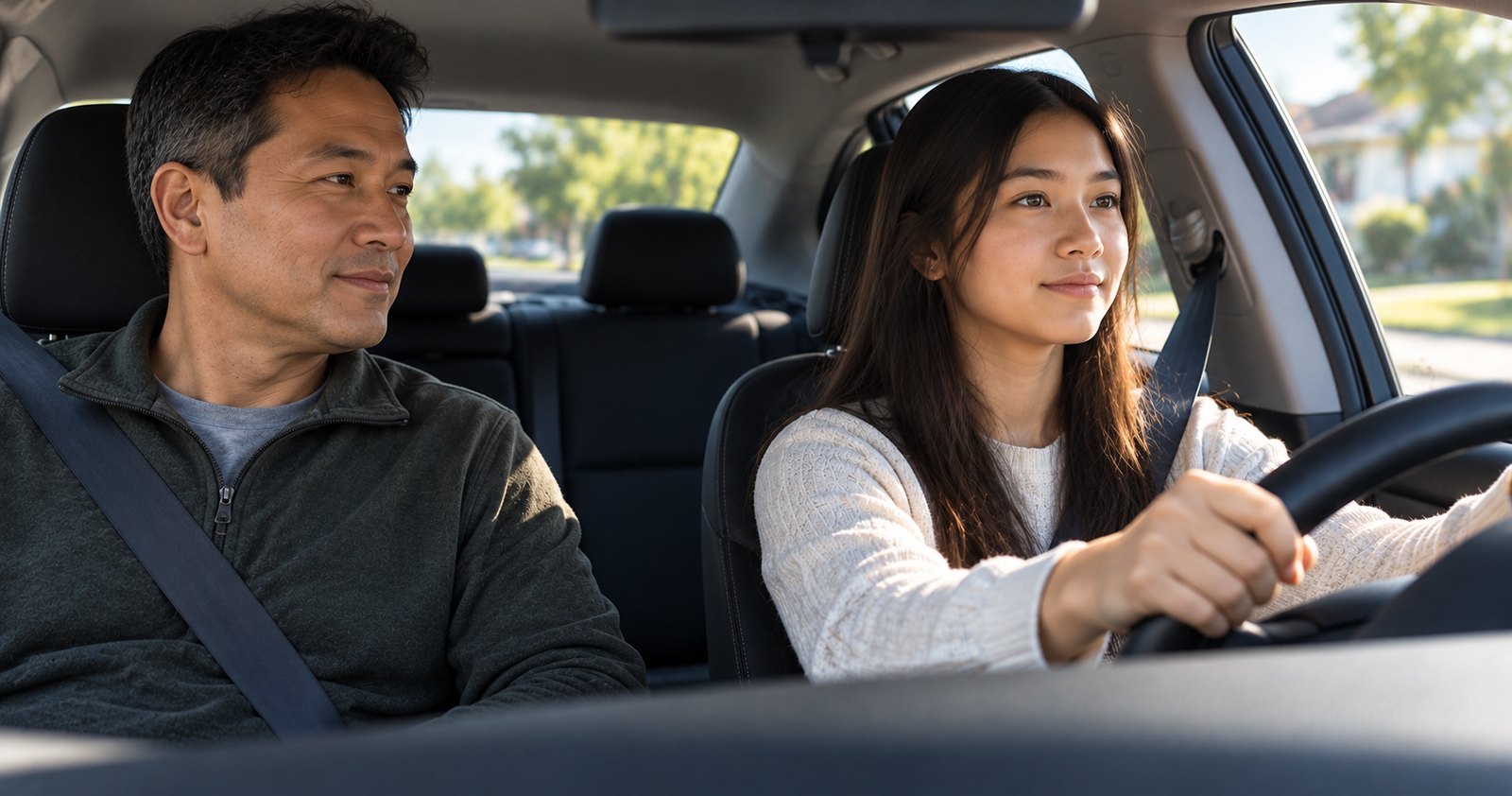
There is a steering wheel on the passenger side of every car with a teenager in it. You can’t see it, but you’ve been using it.
It’s the “you’re clear.” The “wait, wait.” The “okay, go.” The quiet “brake lights” two seconds before your kid would have noticed them. None of it feels like driving. It feels like helping. But every one of those is a decision you made so they didn’t have to.
That’s fine in month two. It’s a problem in month eleven.
What we actually say in the car
Researchers at the University of North Carolina put cameras and microphones in the cars of 50 families during the first four months of supervised driving and listened to more than 2,000 drives. More than half of parents’ comments were about operating the car: steering, braking, where to put your hands. Almost a quarter were the parent telling the teen when it was clear to pull into traffic.
Sit with that second number. Deciding when there’s a big enough gap to pull out is one of the hardest judgments in driving. In a lot of those cars, the parent was making it.
The same study found that the coaching about basics tapered off over the months, which makes sense. What didn’t grow in its place was the harder stuff, like reading what other drivers are about to do. The talking got quieter. The teen’s job didn’t get bigger.
Why it matters the day you get out
A study led by the National Institutes of Health found that teens’ crash and near-crash rate in their first three months of driving alone was about eight times what it had been in the last three months on the permit.
There are plenty of reasons for that jump. Here’s one that’s ours. When you get out of the car, every call you were quietly making gets out with you. The “you’re clear” doesn’t come along. If your teen has never had to make that call alone, the first time they make it is on their own.
The permit year isn’t over when the hours are logged. It’s over when they’re making every call themselves.
Three jobs, in order
It helps to think of the passenger seat as three different jobs, and to notice which one you’re still doing.
Instructor. You tell them what to do. “Signal now. Check your mirror. Ease off.” This is the right job early on, and in the parking lot on day one it’s the only job.
Coach. You ask instead of tell. “What’s your plan at this light?” “Who has the right of way here?” They make the call; you check it.
Passenger. You say nothing unless something is about to go wrong. They plan, decide and drive. You ride.
Most of us move from instructor to a kind of permanent assistant and stay there. The point of the permit year is to spend the last few months mostly in the third job. If you can’t, that’s the most useful thing you can learn before the license, not after.
In the DRVN Readiness Framework, this is independence: the point where you’re no longer supplying a meaningful share of the driving decisions.
DRVN Readiness Framework Control · Awareness · Judgment · Coverage · Independence. See how DRVN evaluates readiness
How to fire yourself, on purpose
Stop saying “you’re clear.” Switch it to a question: “Is it clear?” Then go one step further: “Tell me when you’re going, and why.” The first few times will be slow. Let them be slow. Somebody behind you will honk. You’ll live.
Trade instructions for plans. Before a tricky spot, a left turn across traffic or a highway on-ramp, ask what they’re going to do. Then let them do it. You learn more from a plan they explain than from a plan you hand them.
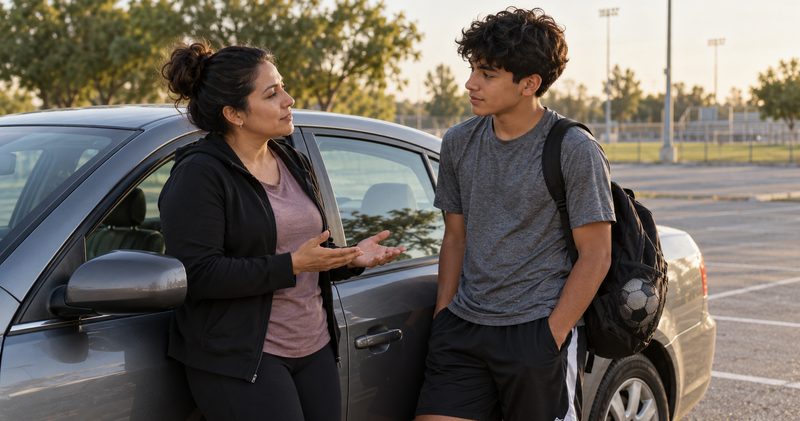
Schedule a silent drive. Agree on it before you leave: you won’t speak unless something is about to go wrong. Pick a familiar route the first time. Then talk about it afterward, in the driveway, not at 40 miles an hour. (How to have that talk without a fight is its own article.)
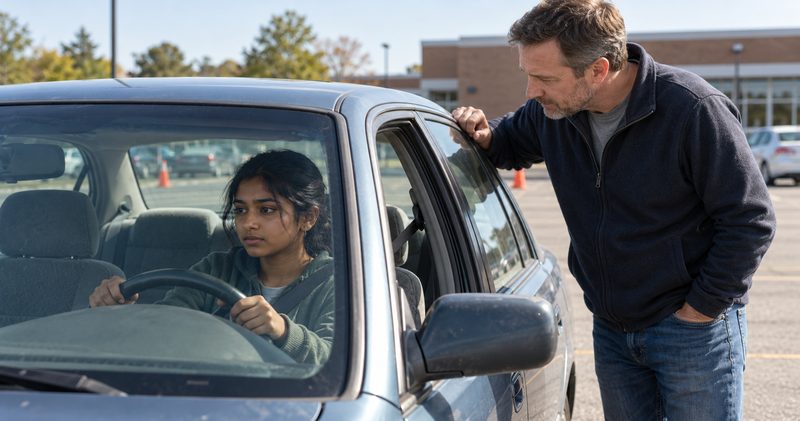
Let small mistakes finish. A missed turn, the wrong lane, a slightly long stop. If nobody is in danger, don’t rescue it. Fixing a mistake is a skill too, and they only get to practice it if you let the mistake happen. The line is safety. Anything that’s actually dangerous, you speak up, every time.
Hand over the planning. Where are we going, which way, what time should we leave, is the weather worth it, do we need gas. Alone, all of that is theirs. Make it theirs now.
Watch your body, not just your mouth. The sharp breath. The foot pressing an imaginary brake. The hand on the door handle. Teenagers read all of it, and they react to it. A silent drive with a lot of gasping isn’t silent.
When you can’t stay quiet
Some drives you won’t make it two blocks. That isn’t failure. It’s information.
Notice where it happens. If you’re fine on the drive to school and talking nonstop on the interstate, that tells you exactly where the practice is thin. The fix isn’t to try harder at being quiet there. It’s more drives there, with you back in the coach’s job for a while. The six environments are a good map of where the gaps usually are.
The goal is for the quiet to be easy, because there’s nothing to say. Not for it to be hard, because you’re biting your tongue.
This week
Take one silent drive on a route your teen knows well. Before you leave, agree on the rule: you only speak if something is about to go wrong.
Keep a mental note of every time you wanted to say something. Afterward, ask them how it felt. Then look at your list. Every item on it is a call you’re still making for them, and that’s the practice plan for the next month.
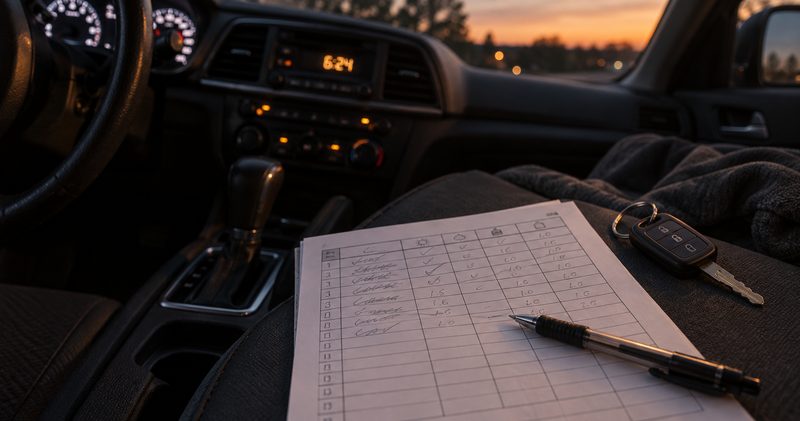
If you want to know how close they are to doing this alone, Ready Isn’t a Feeling has the rest of the checklist.
More on Readiness
- Goodwin et al. Parent comments and instruction during the first four months of supervised driving: an opportunity missed? (Accident Analysis & Prevention, 2014). UNC Highway Safety Research Center, 2014 (50 North Carolina families, in-vehicle recordings) · hsrc.unc.edu
- Teen crash risk highest during first three months after getting driver’s license. National Institute of Child Health and Human Development (NIH), July 2018 · nichd.nih.gov
- Gershon P, Ehsani JP, Zhu C, et al. Crash Risk and Risky Driving Behavior Among Adolescents During Learner and Independent Driving Periods. Journal of Adolescent Health, 2018. doi:10.1016/j.jadohealth.2018.04.012 · pubmed.ncbi.nlm.nih.gov
The research behind this page, with caveats, is in the DRVN evidence library: Crashes and near-crashes were eight times as frequent in teens’ first three months of licensed driving as in their last three months on a permit · During the first months of supervised driving, more than half of parents’ comments are about operating the car, and almost a quarter tell the teen when it’s clear to pull into traffic. Sources checked October 2026.