
Is a Teen Defensive Driving Course Worth It?
One Saturday on a skid pad won't make your kid a safe driver. It might make them a humbler one. Here's what these courses actually do, what they cost, and the insurance question nobody wants to answer straight.
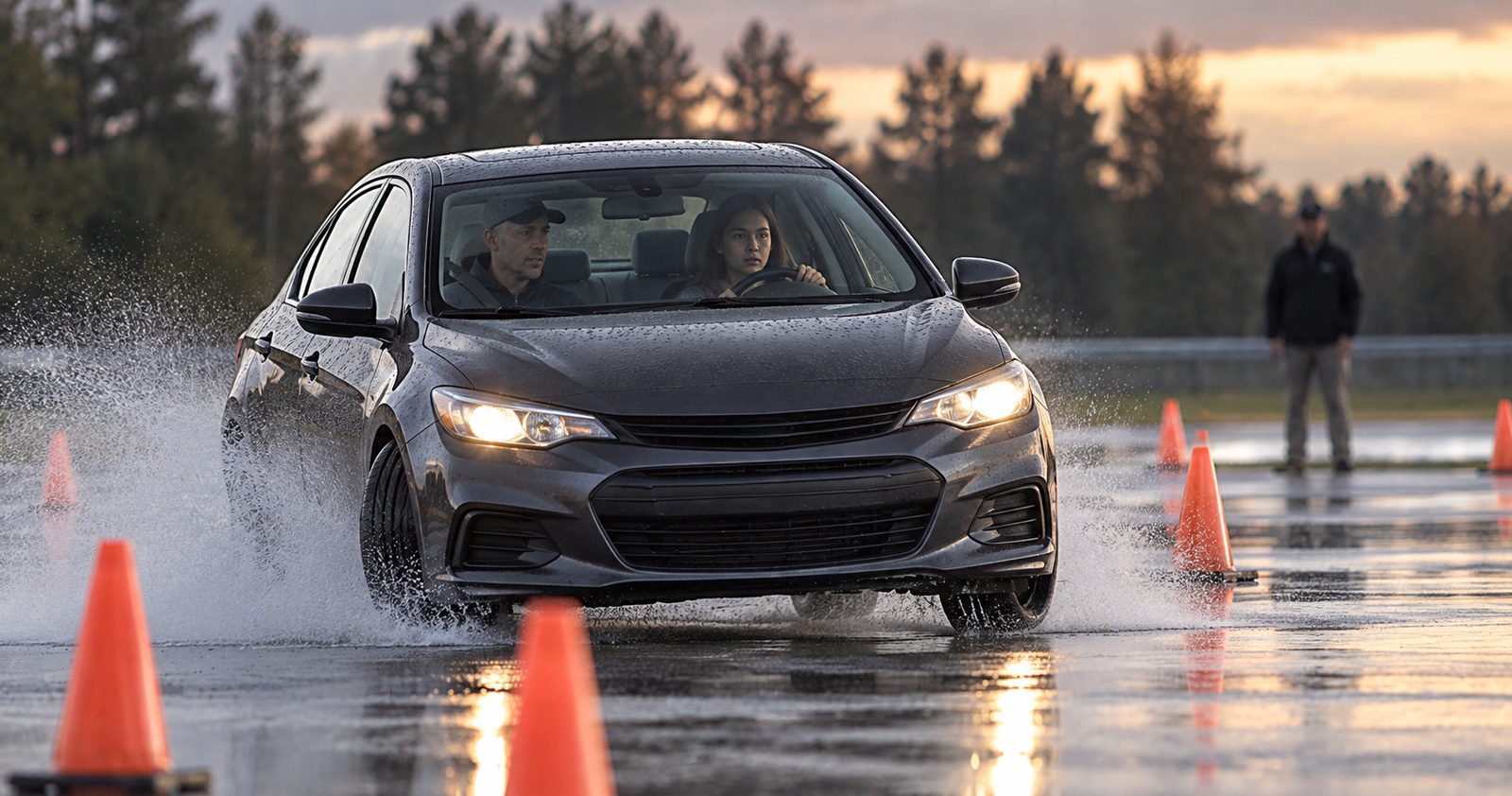
All four of my kids learned to drive in Ohio. All four hit their 50 hours. And all four spent a day sliding a car around wet pavement on purpose, because I paid someone to let them.
We used two programs: Better Ohio Teen Drivers, a Columbus nonprofit run by Mark Bloom, a former race car driver who has been teaching teens car control since 2006, and the teen program at the Mid-Ohio Sports Car Course. If you’ve never watched your child lose a car on purpose while a professional calmly tells them where to look, I recommend it. It is terrifying and wonderful, and it is the most useful thing I have ever spent a Saturday watching.
Our insurance company didn’t reward it. It barely acknowledged it. More on that in a minute.
First, “defensive driving” means two different things
Search the phrase and you’ll get two completely different products mixed together.
The online defensive driving course. A few hours of videos and quizzes on following distance, right-of-way and why texting is bad. It’s the same kind of course adults take to make a speeding ticket go away. Your kid never touches a steering wheel.
The hands-on car-control course. A closed course, your teen behind the wheel, an instructor nearby, and a series of things going wrong on purpose: panic braking, an emergency lane change, a skid on wet pavement. This is the one I’d tell a friend about.
Both have a place. But a lot of parents buy the first one thinking they got the second, and those are not the same Saturday.
What actually happens on the day
Most hands-on programs follow a similar shape. There’s some classroom time on seating position, where to look, and the basic physics of four small patches of rubber holding a two-ton object to the road. Then they go drive.
The drills usually include hard braking to feel the ABS kick in (most teens have never done it, and it startles them), an emergency lane change at speed, a slalom to feel weight shift, and some version of a skid, either on a wet pad or in a car rigged to lose traction on command. Some programs add dropping two wheels off the pavement and getting back on without overcorrecting, which is exactly how a lot of single-car crashes start. If you want to rehearse the at-home version first, Skids, Blowouts and Brake Failure walks through what to talk about before it happens.
Some programs put your teen in the school’s cars. Mid-Ohio uses Honda Civics. Others, like Tire Rack Street Survival, have them bring the car they drive every day, which I like, because that’s the car that will skid on them in February.
What it costs
The range is wider than you’d expect.
- Free: B.R.A.K.E.S., founded by drag racer Doug Herbert after he lost his two sons in a crash, tours the country and asks for a refundable $99 deposit to hold your spot. A parent has to attend the whole session. Ford Driving Skills for Life runs free clinics in different cities each year.
- Around $100 to $200: Tire Rack Street Survival runs through car clubs nationwide at $175. Local Audi, BMW and Porsche club chapters run similar teen clinics.
- Around $400: regional programs like Better Ohio Teen Drivers and Mid-Ohio ($415).
- $1,000 and up: manufacturer and racing schools like the BMW Performance Center ($1,200 for a one-day teen school), Radford and Skip Barber. Beautiful facilities, very nice cars, and you’ll likely be booking a flight.
Expensive doesn’t mean better here. The free and club-run programs are often taught by people who have been doing this for decades.
The part the brochures leave out
I’m going to tell you this because you’ll find it anyway: the research on this kind of training is mixed.
The Insurance Institute for Highway Safety studied a skid-avoidance course for newly licensed teens and found no real difference in crash rates between teens who were offered the course and those who weren’t. In Norway, young men who took a slippery-road course as part of their training had more crashes for a couple of years afterward, not fewer. The leading explanation, backed by Scandinavian research, is overconfidence: a kid who learns to catch a slide starts to think they can handle anything, and the skill itself fades within months.
The programs have their own numbers, and some are impressive. But the families who sign up for a Saturday of extra training are already the families doing more. I know, because I was one of them. That makes it very hard to tell what the course did versus what the parents were already doing.
So why do I still think it’s worth it?
Because I don’t think the value is teaching a 16-year-old to recover a skid. It’s the three seconds when the car stops doing what they told it to. You can lecture a teenager about ice for a year. Watching them feel it happen at 30 miles an hour, with a professional in the passenger seat, gets a respect for speed and space into them that I could never get in by talking.
If your teen comes home saying "I can handle anything now," the day didn't work, and your next few drives together are where you fix that. If they come home a little quieter, it did.
And keep the math honest. Mid-Ohio’s program lists about three hours of drills. That’s three hours against the 50-plus you’re responsible for. A course is a field trip. It is not the curriculum. The 50-Hour Myth is about the rest of it.
Will it lower your insurance?
Short answer: probably not, unless you live in the right state.
Driver’s ed discounts are common. Most big carriers knock something off for completing an approved driver’s education course. That’s the course your teen already has to take, not extra training.
Hands-on car-control courses usually don’t count. Street Survival says plainly there’s no nationwide discount, though many insurers recognize it as an educational program. So it’s worth a phone call with the certificate in hand. Ask specifically whether “advanced driver training” qualifies, and get the answer in writing.
Online defensive driving is the one with real teeth, in a couple of states. In New York, the Point and Insurance Reduction Program requires insurers to cut the base rate of your premium by 10% for three years when a driver completes an approved course, and that includes young drivers who are the principal operator of a car. New Jersey insurers also offer discounts for an approved defensive driving course. If you live in either state, it’s a few hours on a phone and it can pay for itself.
Everywhere else, it’s up to your carrier.
I once got to ask a room full of actuaries from some of the biggest insurers in the country why a teen with more and better training doesn’t pay less. Their answer, more or less: you can’t push the cost of the risk onto the families who won’t put in the work. The good carry the bad.
It’s an honest answer. It is also infuriating. So don’t do this for the discount. If you get one, buy yourself something nice. (If you’re bracing for the bill either way, What a Teen Driver Actually Costs has the numbers.)
How to pick one
- Your teen drives. Not watches, not rides along. Seat time is the whole point.
- You can watch. The good programs encourage parents to sit in and stay. You’ll learn exactly what to reinforce, and you’ll probably learn something about your own driving. I did.
- It talks about staying out of trouble, not just getting out of it. Ask whether they cover speed, following distance and looking far ahead. A program that’s all drifting and no judgment is a thrill ride.
- Timing matters. Most programs want 25 to 30 hours of driving experience first. Somewhere around licensure is the sweet spot: enough skill to get something out of it, close enough to driving alone that it sticks.
- Bring the car they’ll drive, if the program allows it.
The bottom line
The state sets eligibility. You set readiness. A day on a skid pad is one of the better tools I’ve found for helping with the second one, as long as you know what it is and what it isn’t.
It isn’t a shortcut. It won’t fix 15 hours that felt like 50. What it does is give your teen a vivid, slightly scary reference point for how fast things go wrong, and give you something concrete to talk about on every drive after. Ready Isn’t a Feeling has the rest of what to look for.
Those drives are where readiness actually gets built. That’s the part nobody can sell you a ticket to, and it’s the reason I built DRVN.
More on Practice
- Crash and citation records of young drivers with skid avoidance training (Farmer & Wells). IIHS, 2015 · iihs.org
- Phase 2 in the driver education: effect on the accident risk (Glad). Norwegian Institute of Transport Economics (TØI), 1988 · trid.trb.org
- Conflicting goals of skid training (Katila, Keskinen & Hatakka). Accident Analysis & Prevention, 1996 · trid.trb.org
- Frequently asked questions. Tire Rack Street Survival, Checked October 2026 · streetsurvival.org
- FAQs. B.R.A.K.E.S., Checked October 2026 · putonthebrakes.org
- Teen Defensive Driving. The Mid-Ohio School, Checked October 2026 · midohio.com
- Point and Insurance Reduction Program (PIRP). New York State DMV, Checked October 2026 · dmv.ny.gov
The research behind this page, with caveats, is in the DRVN evidence library: Hands-on skid and emergency-maneuver training has not been shown to reduce teen crashes. Sources checked October 2026.