
The Parent-Teen Driving Agreement: Decide the Rules Before Anyone Has the Keys
Most family driving arguments start with an assumption nobody said out loud. Write the rules down while everyone is still calm.
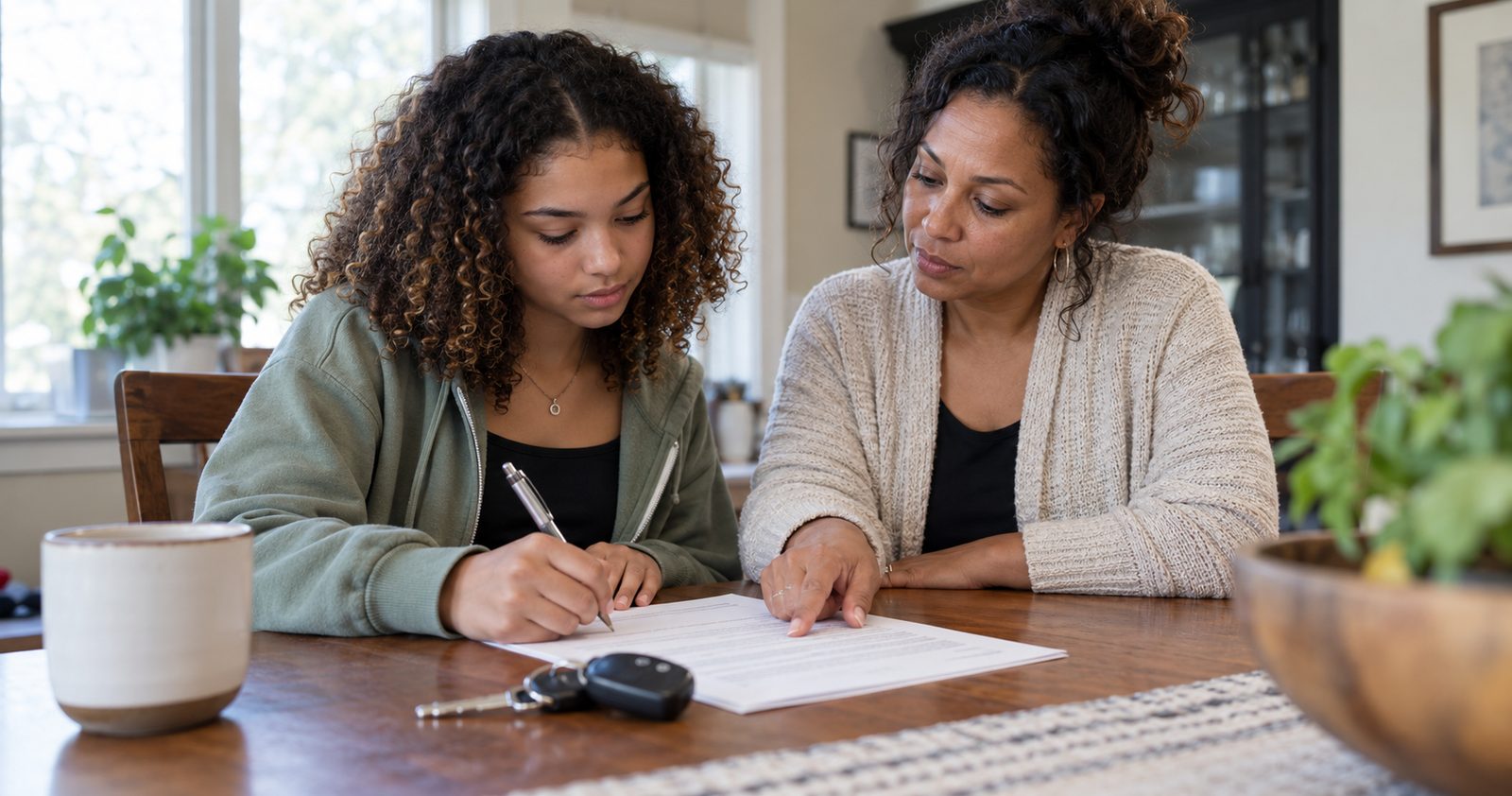
Download the fillable agreement (PDF) · Two pages. Fill it in on screen or print it.
Here’s how the first family driving argument usually starts. It’s 9:45 on a Friday. Your teenager is at a friend’s house, three miles away, and texts: “Can I drive Jordan home?”
You’ve never discussed passengers. You’ve never discussed what time “late” is. So now you’re making policy by text message, in a hurry, with somebody waiting. Whatever you decide, it’ll feel arbitrary to them, because it is.
A driving agreement fixes that. Not because a piece of paper has any power over a teenager. Because the conversation it forces happens early, at the kitchen table, when nobody is in a hurry and nobody is upset.
Write it before the license
The best time to agree on the rules is before the road test, while your teen still needs your signature to get there. After the license, every rule feels like something being taken away. Before, it’s just the plan.
What should a parent-teen driving agreement include?
Our agreement covers the things families actually argue about:
Two rules with no exceptions. Everyone buckles, every trip. And your teen can always call for a safe ride home, with no questions that night. These sit at the top for a reason; more on why in Two Rules With No Exceptions.
Phones. Not “don’t text.” The phone doesn’t get attention while the car is moving. Driving focus on, navigation set before you leave. See Phones and Distraction.
Passengers. With dates. No teen passengers at first, then one, then more, each step after the last one was uneventful. The CDC’s guidance for parents recommends no teen passengers for at least the first six months. See The Friend in the Passenger Seat.
Night driving. A time to be home, and the date it changes. The CDC suggests 9 or 10 p.m. for the first six months. See Night Driving.
Where they can go. School, work, practices, friends in town. Highway, and which highway. What needs a heads-up first.
Weather. What they shouldn’t drive in alone yet, and the agreement to practice rain, snow and night together first.
Check-ins. Text on arrival. Call if plans change. And tell you about close calls without getting in trouble for telling.
The car. Who pays for gas, tickets and damage. Who else drives it. What upkeep is theirs.
What happens if a rule is broken. Decided now, while nobody’s upset.
What parents agree to. This part matters more than it looks. Keep riding along for the hard drives. Follow the phone and seat belt rules ourselves. Pick them up whenever they call. And loosen the rules on schedule when they’ve earned it.
A rule decided in advance is a plan. A rule decided at 9:45 on a Friday is an argument.
How to make it stick
Fill it in together. Not you writing it and them signing. Ask what they think is fair for each section. Teenagers are often stricter on themselves than you’d expect, and they’re much more likely to follow rules they helped write.
Put dates on everything. “No passengers” sounds like forever. “No passengers until March 1, then we’ll look at it” sounds like a plan. The dates are what make it feel fair.
Set the review date and keep it. When it comes, sit down again. Loosen what’s gone well. Talk about what hasn’t. A teenager who sees rules actually relax on schedule has a reason to keep them.
Put it on the refrigerator. Then the paper can do the arguing.
Your state’s rules come first
Most states set passenger limits and night restrictions for new drivers, and they vary a lot. The agreement is where your family goes further than the law, never less. Check what applies to you in your state guide before you fill in the dates.
This week
Download the agreement, print two copies, and do the first page together over dinner. It takes about twenty minutes. It’ll save you a lot of Fridays.
More on Risk
- Eight Danger Zones. CDC, Parents Are the Key, Checked October 2026 · cdc.gov