
The Most Dangerous Thing Your Kid Will Ever Do Is Get a Driver's License
Four kids in, here's what I got wrong the first time — and what the research says almost everybody gets wrong.
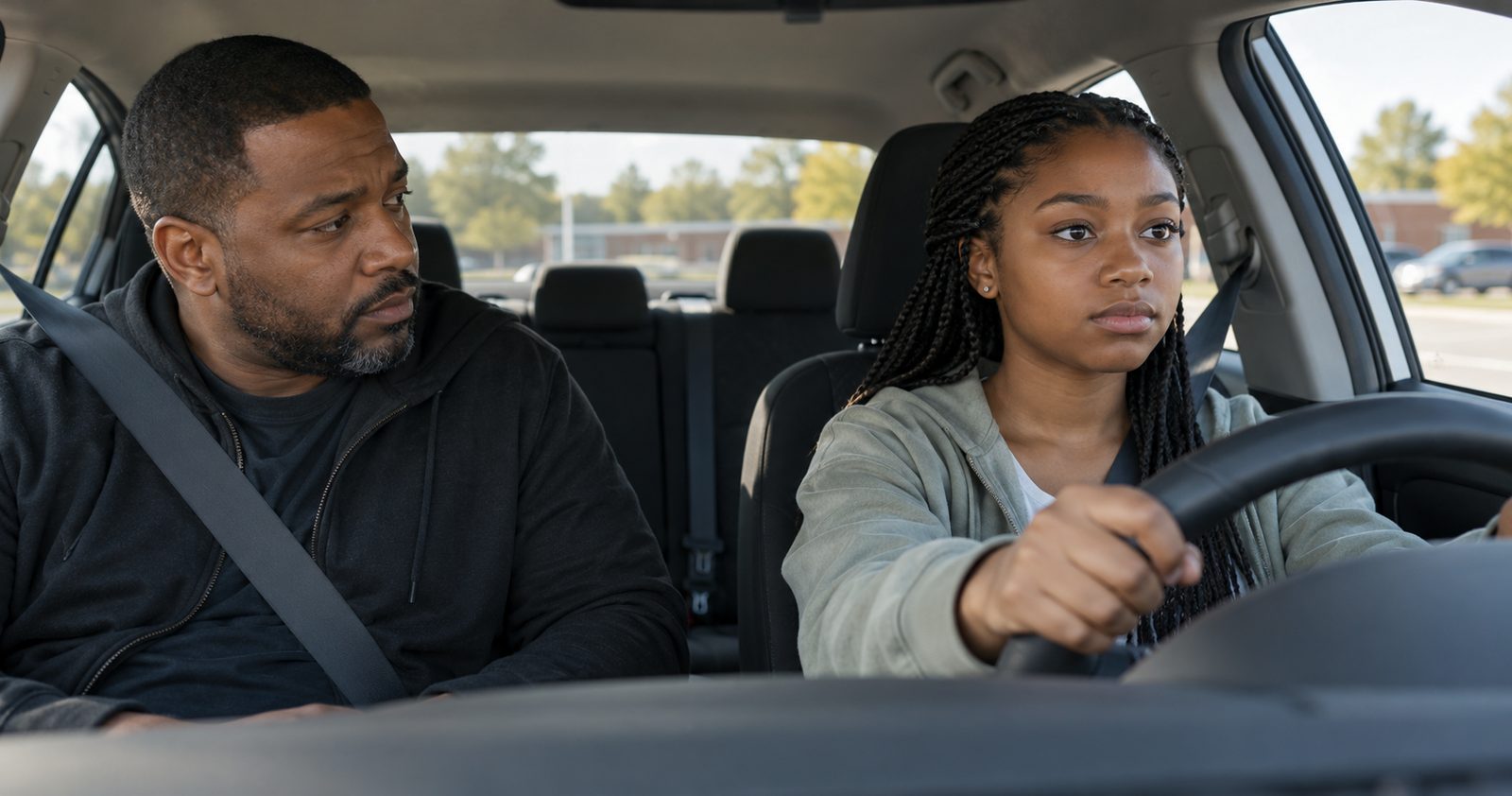
I bought my oldest son a Saab 9-3.
I’d love to tell you there was a thoughtful safety strategy behind this. There wasn’t. Cost mattered. Reliability mattered. But if I’m honest, style mattered more than either. A Saab 9-3 was not particularly remarkable at anything except looking a little different in a high school parking lot.
It just wasn’t a Corolla.
That was basically the argument, and I made it to myself with the solemn confidence of a man who believed he had just made a very responsible parenting decision.
That was about nine years ago. It took three more kids before I understood what that car actually represented: it was the part of the process I could shop for.
That’s the thing nobody warns you about. The car comes with information. You can research crash ratings, argue about mileage, decide whether 82,000 miles is “barely broken in” or “one repair away from financial ruin,” and feel quite reasonably like you are being a responsible parent.
The harder job comes after you buy it. You have to sit in the passenger seat for the better part of a year and turn a fifteen-year-old into someone you are willing to send out alone in two tons of steel at sixty miles an hour. There is no comparison chart for that, and no sequence telling you what they should learn first or how you will know when they are ready.
So most of us do exactly what I did. We handle the car, and then we get into the passenger seat with no real plan.
The number
In 2024, 2,899 American teenagers died from crash injuries. Per mile driven, sixteen-to-nineteen-year-olds have a fatal crash rate about three times that of drivers twenty and over. Count every police-reported crash and it is more than four times.
I’m not going to spend the next thousand words trying to scare you with that number, because frightened parents are not particularly useful. We either white-knuckle the dashboard or decide we would rather not think about it.
What matters is that the risk spikes at a very specific point, and how quickly it comes down has a great deal to do with what happens before you get out of the passenger seat.
The part that changed how I think about all of it
Researchers put cameras and sensors in cars and watched teenagers drive from their learner’s permit through their first year with a license.
While the teenagers were on their permits, with a parent sitting next to them, they drove about as safely as adults. Not “pretty good for beginners.” Comparable to adults.
Then they got licensed.
In their first three months driving alone, their rate of crashes and near-crashes was eight times what it had been during their last three months on the permit.
Source: NIH (NICHD) naturalistic driving study, Journal of Adolescent Health, 2018 · Evidence Library
The kid didn’t change. The car didn’t change. The roads didn’t change.
You left.
That bothered me more than the crash statistics. I had always assumed the dangerous part was learning to drive. The research suggests the dangerous part is the moment we decide the learning is over and get out of the car.
The next finding was just as uncomfortable. Across that entire first year of solo driving, the rates did not meaningfully improve. Experience, by itself, is not much of a teacher.
Miles alone are not a curriculum. They’re just miles.
Which brings me to the paperwork
All four of my kids learned to drive in Ohio, where teenagers are required to complete 50 hours of supervised driving, ten of them at night.
I live in Iowa now. Here, the requirement is 20 hours, with two at night.
Same kid. Same car. Same developing brain. Less than half the supervised practice requirement because you crossed a state line.
Arkansas requires no supervised hours at all and will issue a permit at fourteen. The Insurance Institute for Highway Safety recommends 70.
Nobody can tell you what happens inside a teenager’s brain at hour 20 in Iowa that apparently takes until hour 50 in Ohio. Nothing happens. These are not developmental milestones. They are legislative numbers, and every state picks a different disappointing one.
The trouble starts when we treat those numbers as if they represent a safety standard. They don’t. The state is establishing the point at which your child becomes legally eligible to drive. You have a different job.
The state sets eligibility. You set readiness.
There is another strange wrinkle: in a number of states, your required practice hours go down if your teenager takes driver’s ed.
Ohio made me pay for driver’s ed four times, so I have contributed enough to the industry to have opinions. I am still a believer — six or eight hours with a professional instructor is absolutely worth having, and a good one can teach things an anxious parent in the passenger seat cannot. But it isn’t magic, and it is no substitute for the dozens of hours spent judging gaps in traffic, merging onto a highway, or learning what a wet road feels like when someone pulls out in front of you.
The money, briefly
Adding a teenager to your policy runs about $3,600 a year. In Hawaii that is a 4% bump. In Maine it can be 137%. Your child’s actual driving ability has very little to do with that spread.
I spent years assuming the industry would eventually reward the families doing the work. It doesn’t. I later got to ask a room of actuaries why, and their answer is its own article — but the short version is that reducing this risk is apparently our department.
And we have a conflict of interest
Here is something parents do not say out loud very often: by the time your kid is old enough to drive, you really want them to drive.
School, sports, work, friends, errands — after sixteen years as the family transportation department, the idea that another licensed human being might someday transport themselves is intoxicating.
Which means we are not neutral judges of readiness. We want them to be safe, obviously. We also really, really want them to drive themselves to soccer practice.
Those two goals point in the same direction right up until they don’t. That is when “technically eligible” starts sounding suspiciously like “ready.”
The good news — and it’s real
In a randomized trial, families who followed a structured practice plan — different environments on purpose, night driving, bad weather — cut their teenager’s failure rate on an on-road safety evaluation from 15% to 6%. Roughly the same number of hours. Very different use of them.
Not more time. Better time. And it happens to be one of the few variables in this entire process that belongs almost completely to us.
Three things you can do now
- Pick a planning target, not a finish line. Use 70 supervised hours as the target and spread them out, rather than racing to satisfy whatever number is printed on your state’s form. If your state says twenty, twenty is the paperwork. Readiness is the standard.
- Make a list of conditions, not just hours. Neighborhood streets, busy arterials, rural two-lanes, highway, darkness and hard rain. Six environments — and most teenagers get licensed having driven in two of them.
- Decide now that the license is not the finish line. The day the state removes a restriction does not have to be the day you remove yours. Passengers, darkness, weather and distance can all be introduced in stages — earned rather than scheduled.
Here’s my real confession
I was not some disaster of a driving parent. I didn’t scream. I didn’t grab the wheel. There are probably no great stories my kids will someday tell a therapist about learning to drive with me.
I did something much more ordinary.
I got in the car.
We would be headed somewhere anyway, so my son would drive. I did not have a skill in mind for that day — I wasn’t thinking about lane position, intersections or judging gaps in traffic. We drove somewhere, I called it practice, and eventually I signed the form.
All four kids ultimately learned to drive, so it would be very easy to look back and decide the process worked.
We got through it. That is different from having a plan.
I knew that with the first one. I was in the car with my oldest son, doing my best, and I could not have told you whether we were building a driver or just accumulating miles. The three who followed only confirmed it. What I wanted was a plan that fit the life I actually had — not one that made sense on paper — and not being able to find one is why I eventually built it.
That is what this series is about. Not turning you into a professional instructor, and not making the next year of your life another full-time job. Just what matters, what to practice, and how to make the time you are already spending count for more.
Because eventually you are going to get out of that passenger seat.
And they are going to keep driving.
More on Risk
- Teenagers. Insurance Institute for Highway Safety (IIHS), 2024 data · iihs.org
- Teen crash risk highest during first three months after getting driver’s license. National Institute of Child Health and Human Development (NIH), July 2018 · nichd.nih.gov
- Gershon P, Ehsani JP, Zhu C, et al. Crash Risk and Risky Driving Behavior Among Adolescents During Learner and Independent Driving Periods. Journal of Adolescent Health, 2018. doi:10.1016/j.jadohealth.2018.04.012 · pubmed.ncbi.nlm.nih.gov
- Mirman JH, Curry AE, Winston FK, et al. Effect of the Teen Driving Plan on the Driving Performance of Teenagers Before Licensure: A Randomized Clinical Trial. JAMA Pediatrics, 2014. doi:10.1001/jamapediatrics.2014.252 · pubmed.ncbi.nlm.nih.gov
- TeenDrivingPlan Research. Children’s Hospital of Philadelphia, Center for Injury Research and Prevention, Checked October 2026 · injury.research.chop.edu
- Graduated Driver Licensing. Ohio Bureau of Motor Vehicles, Checked October 2026 · bmv.ohio.gov
- The Parent’s Supervised Driving Program (PDF). Iowa Department of Transportation, 2021 edition · iowadot.gov
- Learner’s and Intermediate License. Arkansas Department of Finance and Administration, Checked October 2026 · dfa.arkansas.gov
- How much does it cost to add a teenager to car insurance?. CarInsurance.com, Updated August 2026 · carinsurance.com
- Graduated licensing laws (state-by-state table). IIHS, Checked October 2026 · iihs.org
- Young Driver. Pennsylvania Department of Transportation, Checked October 2026 · pa.gov
- Simons-Morton BG, Ouimet MC, Zhang Z, et al. Crash and Risky Driving Involvement Among Novice Adolescent Drivers and Their Parents. American Journal of Public Health, 2011. doi:10.2105/AJPH.2011.300248 · pubmed.ncbi.nlm.nih.gov
- Fatality Facts 2024: Teenagers. IIHS, 2024 data · iihs.org
The research behind this page, with caveats, is in the DRVN evidence library: Required supervised practice ranges from none to 65 hours depending on the state · Crashes and near-crashes were eight times as frequent in teens’ first three months of licensed driving as in their last three months on a permit · Time behind the wheel alone doesn’t bring a new driver’s risk down quickly · Per mile driven, drivers 16 to 19 crash at more than four times the rate of drivers 20 and older · Teens whose families followed a structured plan across varied environments were less likely to fail an on-road driving assessment · Adding a teen to a parent’s car insurance costs about $3,600 a year on average. Sources checked October 2026.