
The Friend in the Passenger Seat
One friend raises a new driver's risk. Three can quadruple it. An adult in the car cuts it sharply.
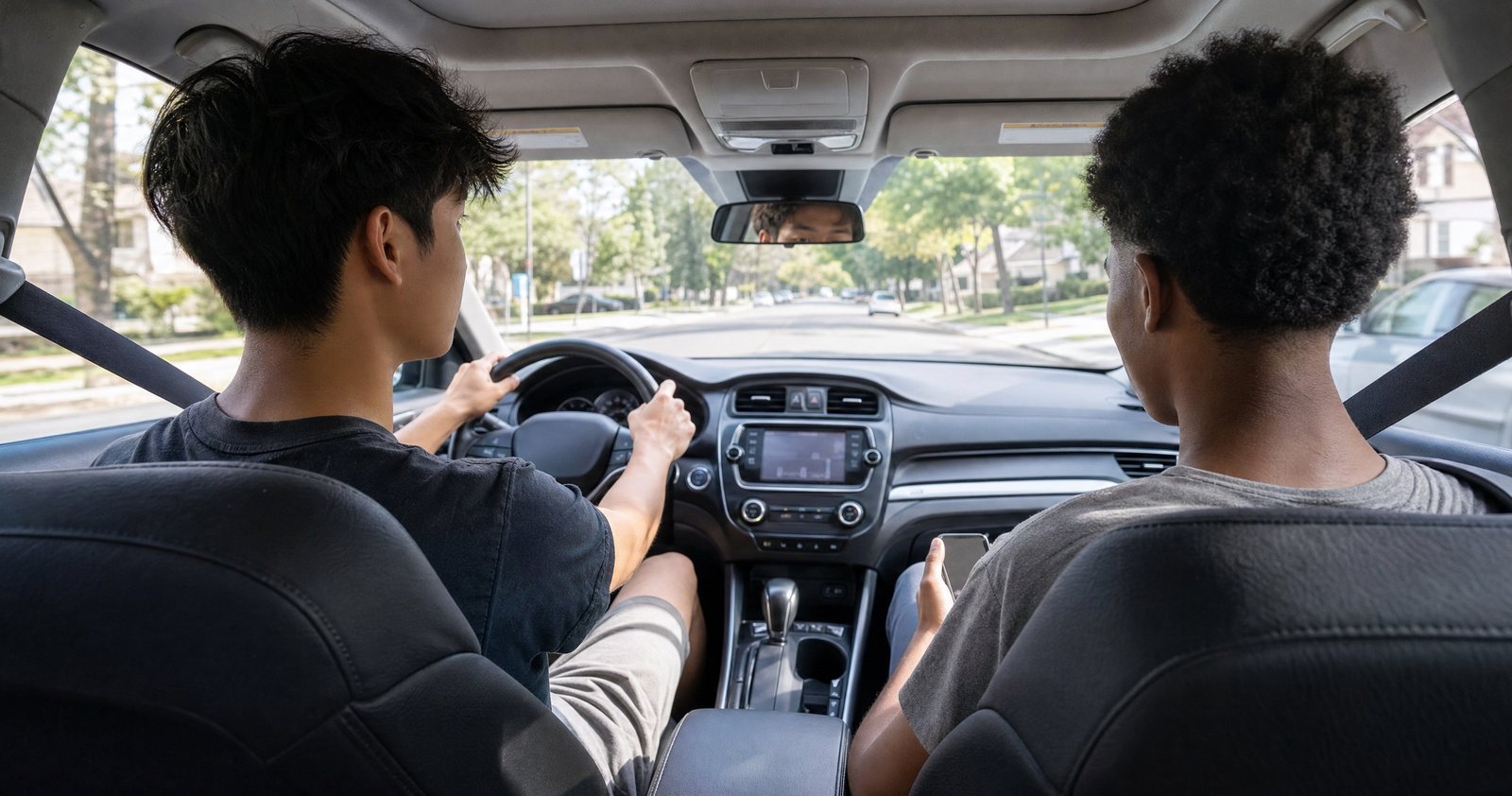
Teenagers are not, in my experience, quiet passengers.
Somebody’s choosing music. Somebody’s showing a video. Somebody wants to stop for food, then changes their mind, then changes it back. And somewhere in the middle of all that, a sixteen-year-old with a few months of experience is trying to judge a left turn across traffic.
That’s the whole problem, really. A new driver has very little attention to spare, and friends are designed to take it.
How much do teen passengers increase crash risk?
The AAA Foundation for Traffic Safety looked at the risk of death for 16- and 17-year-old drivers per mile driven. Compared with driving alone, one passenger under 21 raised it by 44%. Two passengers doubled it. Three or more quadrupled it.
Source: AAA Foundation for Traffic Safety, Teen Driver Risk in Relation to Age and Number of Passengers, 2012 · Evidence Library
Same study, other direction: a passenger 35 or older cut the risk by 62%. That’s you, by the way. The most protective thing in the car is an adult.
And when dashcams recorded actual teen crashes, interacting with a passenger was the single most common distraction, present in 15% of them. More common than phones.
The risk doesn’t come from bad friends. It comes from friends.
It isn’t about who the friends are
This is the part parents get wrong, and I understand why. We assume the danger is the wild friend, the one who eggs them on. So we approve the nice kid and say no to the other one.
The research doesn’t sort friends by character. The risk rises with each additional teen or young adult in the car, according to the CDC. A carful of honor students talking about chemistry is still a carful of distraction for someone who doesn’t have attention to spare yet.
So make the rule about the number, not the names. It’s fairer, it’s easier to enforce, and it doesn’t turn into a fight about whether you like their friends.
What are the passenger rules for new drivers?
Most states limit passengers for new drivers, but the limits vary a lot, and many expire after a few months. Colorado, for example, allows no passengers under 21 for the first six months, then one, with siblings exempt. Other states are looser.
The CDC’s guidance for parents is simpler: no teen or young-adult passengers for at least the first six months. If your state allows more, you’re allowed to be stricter. What the law permits on day one and what your family permits on day one can be two different lists.
What passenger rule should parents set?
Here’s a version that works for a lot of families:
- Months 1–6: no teen passengers. Siblings only if you’ve agreed to it, and only on routine trips.
- After six months: one passenger, daytime.
- Later: one passenger at night. Then two, once one has been uneventful for a while.
- Always: the driver is in charge of the car. Music, phone, stops and destination are the driver’s call, and passengers who don’t like it can get a ride with someone else.
Give your teen the line they’ll need: “My parents check.” Let them blame you. It costs you nothing, and it gets them out of an awkward conversation in a parking lot with five people waiting.
Make the plan before the friends ask
The first request will come within a week of the license. “Can I drive Sam home?” If the answer depends on your mood that evening, you’ll negotiate it every single time.
Decide the passenger rule before the road test, write it down, and put an end date on each stage. Then, when Sam needs a ride, nobody has to argue. The answer was decided months ago.
More on Risk

- Teen Driver Risk in Relation to Age and Number of Passengers (Tefft, Williams & Grabowski, 2012). AAA Foundation for Traffic Safety, May 2012 (crash data 2007–2010) · aaafoundation.org
- Using Naturalistic Driving Data to Assess the Prevalence of Environmental Factors and Driver Behaviors in Teen Driver Crashes (Carney et al., 2015). AAA Foundation for Traffic Safety, March 2015 (1,691 crashes, 2007–2013) · aaafoundation.org
- Risk Factors for Teen Drivers. Centers for Disease Control and Prevention (CDC), Reviewed August 2025 · cdc.gov
- Eight Danger Zones. CDC, Parents Are the Key, Checked October 2026 · cdc.gov
- Graduated licensing laws (state-by-state table). IIHS, Checked October 2026 · iihs.org
The research behind this page, with caveats, is in the DRVN evidence library: Each teen or young-adult passenger adds to an unsupervised teen driver’s crash risk. Sources checked October 2026.