
The Permit Year, Month by Month
Most families run the year backwards. Here's the order the skills actually build in.
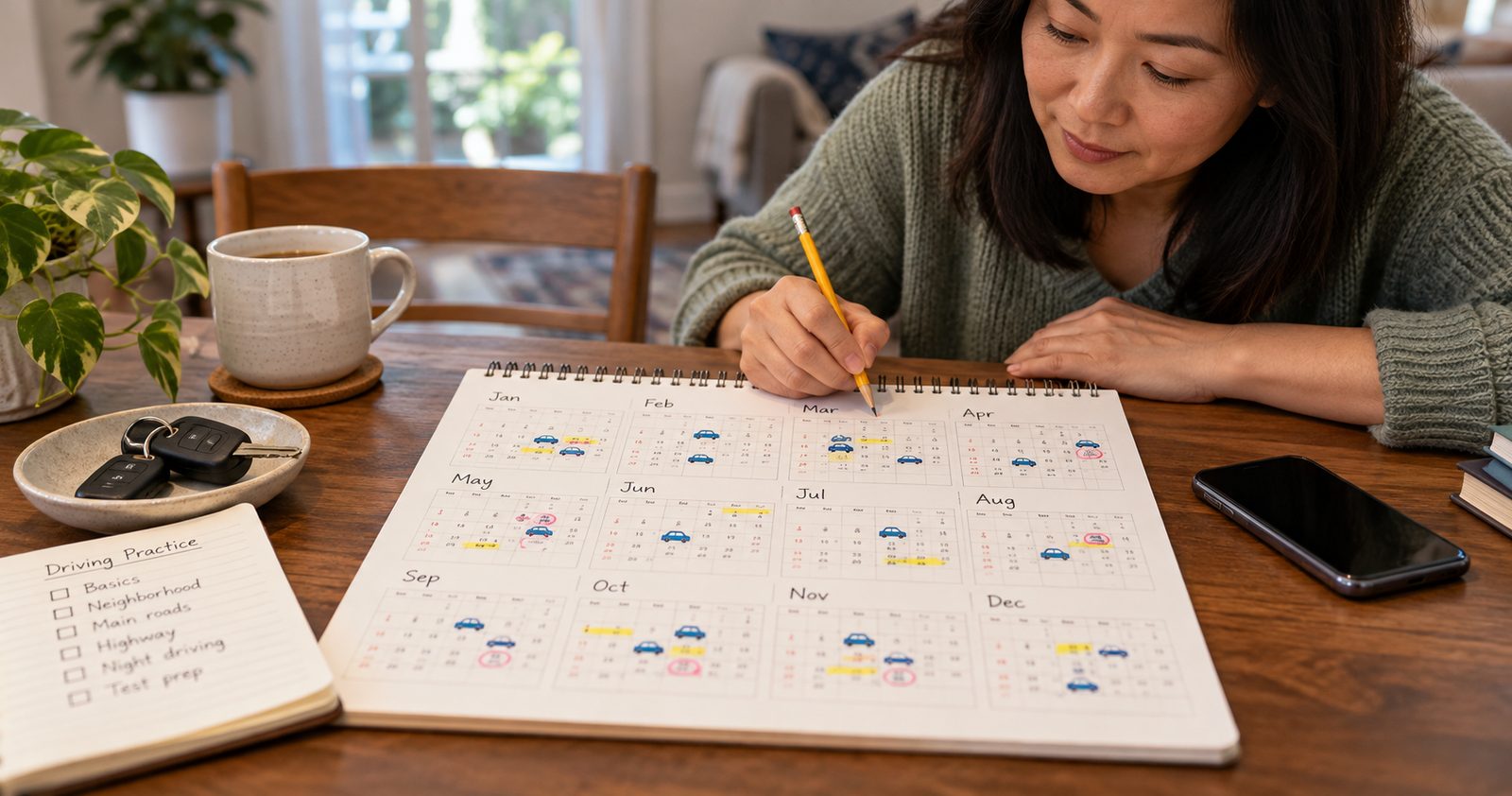
A permit year has a shape, and it is almost always the same shape.
The first few weeks are intense. Everybody is nervous, everybody is paying attention, and you go out three times a week. Then it settles into something comfortable, and comfortable turns into the same roads, and somewhere around month five the whole thing goes quiet. You’re still driving together. Nothing is really happening.
Then the birthday appears on the horizon and there’s a scramble. Suddenly you’re trying to get highway time and night hours and something resembling weather experience into about six weeks, because the license is coming whether or not you’re ready for it.
That is exactly backwards. The hard environments need the most repetition and the widest range of conditions, which means they need the most calendar — and they’re the ones that end up with the least.
The fix isn’t more discipline. It’s sequence.
Why the order matters more than the hours
Driving skills stack. Each one assumes the one below it has become automatic.
A teenager who is still actively thinking about lane position cannot also judge a gap in oncoming traffic, because judging that gap requires attention they don’t have spare. Put them on a highway in that state and they aren’t learning to merge — they’re surviving a merge, which teaches almost nothing and frightens everybody.
Most of the wasted hours in a permit year are spent on step four while step two is still unfinished. That’s what makes sequencing worth more than volume: get the order right and the same forty minutes teaches twice as much.
What this plan assumes about your life
Most practice plans are written as though you have free evenings and a spare vehicle. This one assumes what’s actually true:
- Practice happens during errands. Almost all of it. The plan has to run on trips you were making anyway.
- Sessions are twenty to forty minutes, not two hours.
- Weather and daylight don’t consult your calendar. You take those when they arrive, out of order, whenever they show up.
- Some months nothing will happen. Someone will be in a play, or on crutches, or you’ll be traveling. Build that in rather than treating it as failure.
Months 1 to 3 — Control
The goal is that the car stops being a thing they operate and becomes a thing they drive.
Where. An empty lot for the first two or three sessions, then quiet residential streets. Nothing with a center line for at least a couple of weeks.
What. Smooth braking and acceleration. Lane position. Mirrors. Looking far enough ahead that the windshield stops being the whole world. Reversing and parking, done badly many times.
How often. Short and frequent beats long and occasional. Twenty minutes three times a week is worth more than two hours on Sunday.
You know you’re done when. They can drive a familiar three-mile route while you say nothing at all, and neither of you finds that stressful.
Months 4 to 6 — Judgment
The goal shifts from operating the car to reading what’s around it.
Where. Commercial arterials. Multi-lane roads with driveways, turn lanes, and other drivers doing unreasonable things.
What. Gap judgment, especially unprotected left turns. Following distance. Choosing a speed for conditions rather than for the sign. Lane changes with a purpose.
Add this. Start asking “what’s the risk here?” at random moments, and make them answer. Not a quiz. A habit. The goal is that they’re scanning for hazards before you name one.
You know you’re done when. They pick safe gaps without you saying anything, and they start narrating hazards to you unprompted.
Months 7 to 9 — The hard environments
This is the stretch families skip, and skipping it is the single most common failure of a permit year.
Highway. Start with a quiet rural interchange. Then a suburban ramp. Then one with truck traffic. Then rush hour. Four sessions minimum, in that order, spread over weeks rather than crammed into a weekend.
Night. Begin at dusk on roads they know, then unfamiliar roads after dark, then rain at night, which is the hardest condition most drivers ever face. Go well past whatever your state asks for; two hours is a couple of drives home from a game.
Rural. A deliberate loop that accomplishes nothing except itself. No shoulder, changing surfaces, blind crests, and the practice of choosing a speed from the road rather than the sign.
Weather. This one ignores the calendar. Take the first hard rain whenever it comes, in month two or month eleven. The rule is simply that you stop canceling.
Months 10 to 12 — Independence rehearsal
The goal for the last quarter is to remove yourself while still sitting there.
They navigate. Unfamiliar destinations, no directions from you, phone mounted and set before you leave. Finding your way and driving are different skills, and only one of them gets practiced while a parent holds the map in their head.
Silent drives. You say nothing unless it’s a safety issue. Debrief afterward instead. This is harder for the parent than the teenager and that is rather the point.
They own the trip. Route, departure time, where to park, what to do when the lot is full. All the small decisions you have been quietly making for them.
You know you’re ready when. They drive forty-five minutes somewhere new, in traffic, and you didn’t speak and didn’t need to.
If you started late
Plenty of families arrive at month nine having done month three. It’s recoverable, and the recovery rule is simple.
Compress repetition, never environments. Do fewer sessions in each phase if you must, but do not cut night, weather, highway or rural — those are the ones the year exists for, and they’re the ones that get sacrificed when time runs short.
And consider moving the license date rather than the plan. A birthday is a date on a calendar. Readiness is a separate question, and you are the only person in a position to answer it.
The five minutes that keep this alive
Once a month, on a Sunday, ask yourself three questions.
Which of the six environments haven’t we touched? What’s the weakest thing they do? What’s one thing we’ll work on in the next four weeks?
That’s it. Five minutes, twelve times. It is the difference between a plan and a folder.
The plan isn’t really the point, in the end. The point is that on a Tuesday at 5:40, with forty minutes of daylight left and a store you need to get to anyway, you don’t have to decide anything.
You already decided. Back when you had time to think.
More on The Permit Year
- TeenDrivingPlan Research. Children’s Hospital of Philadelphia, Center for Injury Research and Prevention, Checked October 2026 · injury.research.chop.edu
- Mirman JH, Curry AE, Winston FK, et al. Effect of the Teen Driving Plan on the Driving Performance of Teenagers Before Licensure: A Randomized Clinical Trial. JAMA Pediatrics, 2014. doi:10.1001/jamapediatrics.2014.252 · pubmed.ncbi.nlm.nih.gov
- Teenagers. Insurance Institute for Highway Safety (IIHS), 2024 data · iihs.org
- Risk Factors for Teen Drivers. Centers for Disease Control and Prevention (CDC), Reviewed August 2025 · cdc.gov
The research behind this page, with caveats, is in the DRVN evidence library: Teens whose families followed a structured plan across varied environments were less likely to fail an on-road driving assessment · More than half of teen driving deaths happen between 6 p. Sources checked October 2026.